
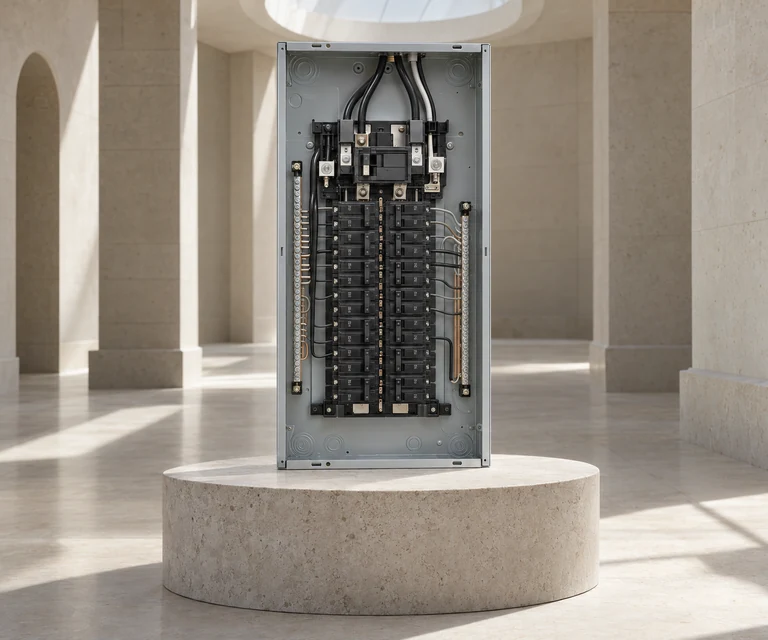
Brand hall
Eaton
Seven truck axles built by hand in 1911; a century later, the panel on the basement wall.
Eaton · Dublin, Ireland · est. Bloomfield, N.J., 1911Eaton Corporation plc · NYSE: ETN
Eaton reached the breaker panel the long way: truck axles in New Jersey, motor controls from Milwaukee, and a century of acquisitions that folded Cutler-Hammer and the Westinghouse distribution lines into one catalog. This hall sets out that record, from a 1911 machine shop to Eaton Corporation plc, then turns to the working anatomy of the residential loadcenter — Type BR and Type CH breakers, their arc-fault and ground-fault variants, and the label-reading habit that keeps the right breaker in the right panel.
Wing I
The record
The register, in eight exhibits.
Exhibit 01 — 1893
Milwaukee roots of the breaker line
Harry H. Cutler and Edward W. Hammer incorporated Cutler-Hammer Manufacturing Co., a maker of electric motor starters and control devices that settled in Milwaukee in 1899. Eaton's residential electrical business traces its lineage to this firm.
Exhibit 02 — 1911
Seven axles, built by hand
Joseph O. Eaton, Viggo V. Torbensen and Henning O. Taube incorporated Torbensen Gear and Axle Co. in Bloomfield, New Jersey, to manufacture Torbensen's patented internal-gear truck axle. The shop produced seven axles in its first year.
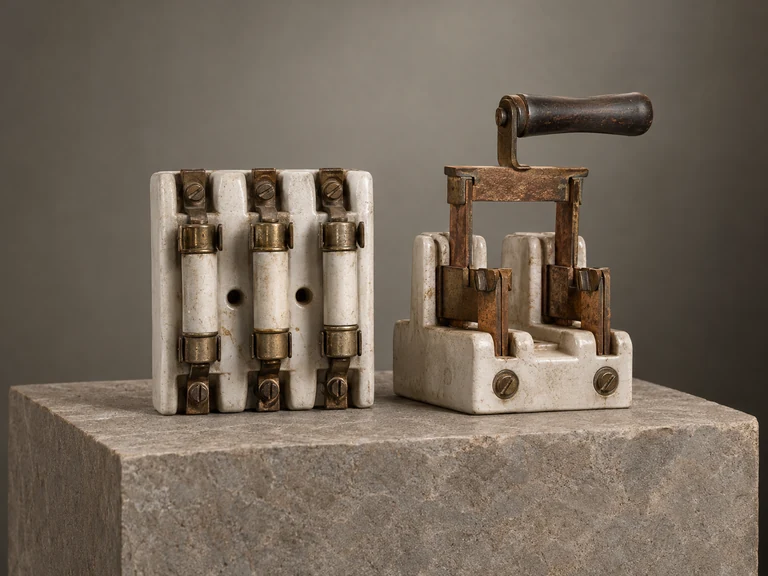
Exhibit 03 — 1923
The founder's name goes on the door
Now based in Cleveland, the axle maker took its co-founder's name, becoming Eaton Axle & Spring Co. Later mergers brought the name Eaton Yale & Towne in 1966, as the product range spread well beyond axles.
Exhibit 04 — 1971
Eaton Corporation
Eaton Yale & Towne shortened its name to Eaton Corporation. The simplified name marked the company's evolution from a single-product axle supplier into a diversified industrial manufacturer headquartered in Cleveland.
Exhibit 05 — 1978
Cutler-Hammer joins Eaton
Eaton acquired Cutler-Hammer, adding a portfolio of power control and switching devices. The Cutler-Hammer name carried Eaton's electrical distribution business — residential breakers included — for decades before the branding transitioned to Eaton.
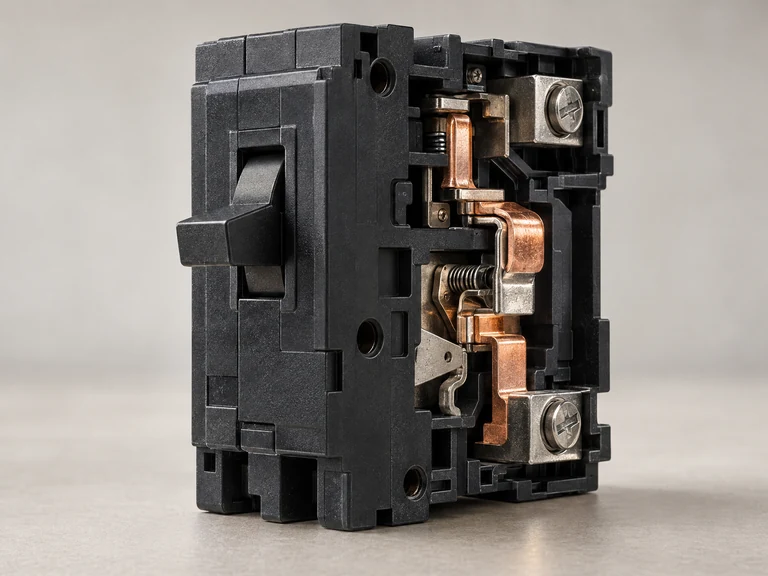
Exhibit 06 — 1994
The Westinghouse distribution lines
Eaton purchased Westinghouse's Distribution and Control Business Unit for $1.1 billion in cash plus assumed liabilities and merged it into Cutler-Hammer. The deal brought Westinghouse's electrical distribution products — circuit breakers among them — and moved Eaton to the front rank of power distribution.
Exhibit 07 — 2012
Cooper Industries; Eaton Corporation plc
Eaton completed the roughly $13.2 billion acquisition of Cooper Industries. Both companies became subsidiaries of the newly created Eaton Corporation plc, incorporated in Ireland, with shares trading on the New York Stock Exchange under Eaton's symbol, ETN.
Exhibit 08 — 2025
Intelligent power management
Eaton describes itself as an intelligent power management company. It reported record 2025 revenues of $27.4 billion, up 10 percent from 2024, and serves customers in 180 countries.
Interactive exhibit
One panel, opened
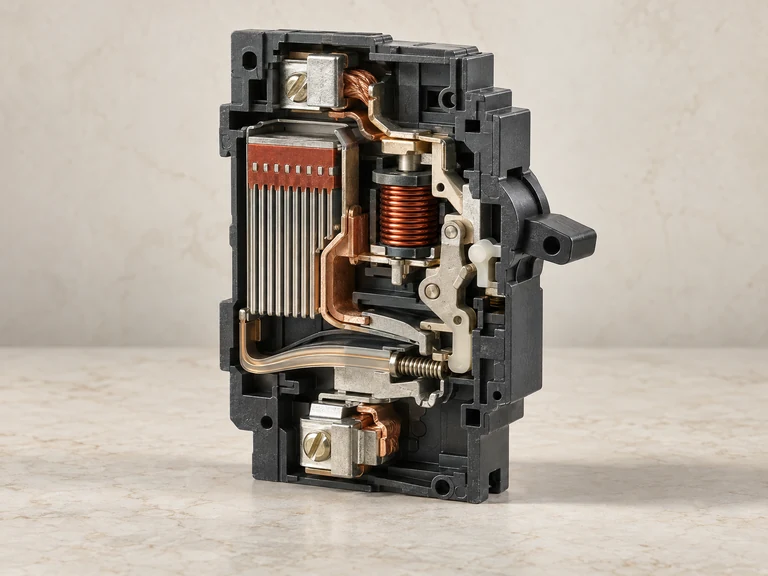
A load center, separated into bus, breakers, and bars. Open the numbered plates.
- 01
Main breaker
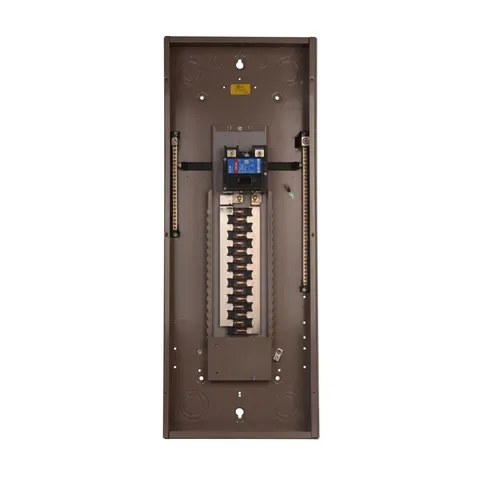
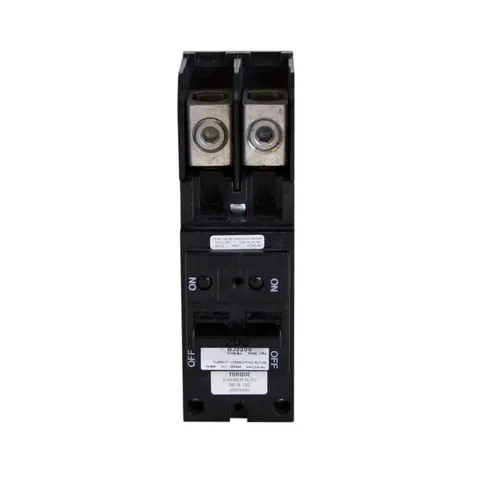
In a main-breaker loadcenter, one device provides overcurrent protection for the entire panel. Main-lug-only panels omit it: incoming cables land directly on the bus lugs, with the main protection located upstream. The main's ampere rating — commonly 100, 125 or 200 — sets the panel's service capacity, and its label is part of the panel's listing.
- 02
Bus bars
The energized spine of the panel. Each branch breaker's line side clips onto a bus stab to complete the circuit, and the stab geometry is specific to the series — one reason a 3/4-inch CH breaker and a 1-inch BR breaker are not interchangeable. Eaton's CH literature notes one-piece silver-flashed copper bus in its loadcenters.
- 03
Branch breaker body
Type BR and Type CH residential breakers are thermal-magnetic devices: a thermal element opens the circuit on sustained overload, a magnetic element on short circuit. Handles carry ON-OFF indication and the ampere rating. Eaton notes that Type CH breakers trip to the OFF position rather than resting at a midpoint after a fault.
- 04
Neutral bar
The termination point for circuit return conductors. Standard AFCI and GFCI breakers also land a coiled pigtail here. Eaton's plug-on neutral loadcenters and matching breakers make that neutral connection directly at the bus, removing the pigtail — a design covered in Eaton's residential installation literature.
- 05
Ground bar
Where equipment grounding conductors terminate. In Eaton loadcenters, ground bars mount to the enclosure wall and are sized to the circuit count. Whether neutral and ground are bonded at this particular panel depends on its role — service equipment or subpanel — a determination that belongs to local code and the installer.
Stylized CGI rendering — an illustration of a load center's parts, not an Eaton drawing.
The platforms, explained
Type BR. Type CH. The protectors.
Two breaker families that never share a panel, and the arc- and ground-fault line that protects both. The cards keep them apart.
1-inch
Type BR
Eaton's 1-inch residential breaker line. BR breakers serve indoor and outdoor BR loadcenters, spa panels, meter breakers and subpanels, in thermal-magnetic, AFCI, GFCI and dual-function versions. Eaton backs BR breakers with a 10-year limited warranty under terms effective June 1, 2024, applied by manufacture date. The volume line of the two series, common in new construction and service upgrades.
FitsBR loadcenters; panels labeled for Type BR
3/4-inch
Type CH
Eaton's 3/4-inch residential line, recognized in the trade by its tan handle, with initials kept from the Cutler-Hammer era. Type CH breakers trip to the OFF position — a feature Eaton says eliminates nuisance callbacks — and carry a limited lifetime warranty. CH loadcenters pair them with silver-flashed copper bus, per Eaton's product literature.
FitsType CH loadcenters only
AF/GF
Protective breakers
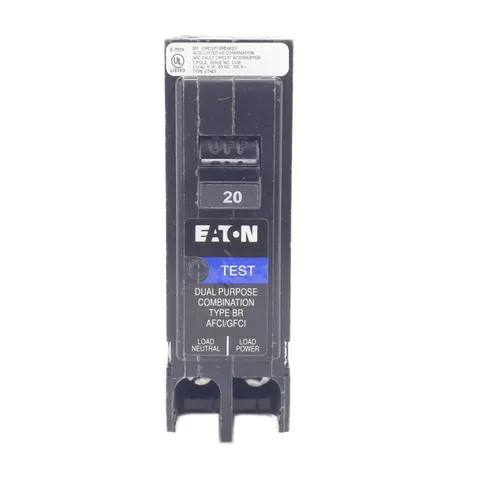
The AFCI, GFCI and dual-function family, offered in both BR and CH frames. Combination AFCI breakers detect persistent arcing faults — a hazard Eaton cites in more than 28,000 U.S. home fires a year. GFCI breakers open at a 5 mA ground-fault threshold to reduce shock risk. Dual-function units combine both protections in one device. Where each is required is a local-code question.
FitsBoth frames — match the panel series first
Breaker and panel are listed as a system. Eaton lists Type BR breakers only for panels whose labeling accepts Type BR; Type CH breakers fit only Type CH loadcenters. Never install one series' breaker in another series' panel — the label inside the panel door is the authority.
Read the label
Reading the breaker label
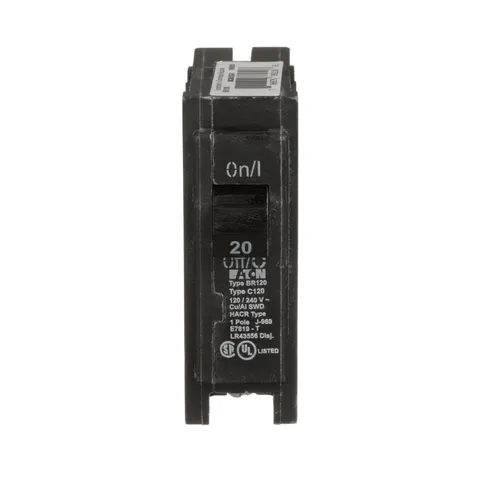
Specimen: BRCAF120 — series, protection, poles and amperes in one string.
BR
Series — the panel decides
The leading letters name the series, and with it the panel. Eaton lists Type BR breakers for panels whose labeling accepts Type BR; Type CH breakers install only in Type CH loadcenters. The two lines are different widths — 1 inch and 3/4 inch — on different bus designs, so a wrong-series breaker fails physically and fails the listing. Read the panel door label before anything else.
CAF
Protection code
The protection letters state what the breaker guards against beyond overload and short circuit — and their position in the string varies. CAF sits between series and digits: BRCAF120 is a combination arc-fault (CAFCI) breaker, which detects persistent arcing faults. GF marks ground-fault protection at the 5 mA personnel level and leads the catalog number in the BR line — GFTCB120 carries no BR prefix at all. DF trails the digits on dual-function breakers such as BRN120DF and CHFN120DF, combining arc-fault and ground-fault protection in one device. No protection letters — BR120 — means standard thermal-magnetic.
120
Poles first, then amperes
Read the digits as pole count, then ampere rating. 120 is a single-pole, 20-ampere breaker for a 120-volt circuit; 2100 is a two-pole, 100-ampere breaker spanning both bus legs for 240-volt loads such as ranges and dryers. Eaton's own listings confirm the pattern — BR120 is single-pole 20 A, BR2100 two-pole 100 A. The ampere number protects the wire, so the circuit fixes it, not preference.
Suffix letters (CS, N and others) denote packaging and connection variants across product generations; confirm any substitution against Eaton's catalog and the panel labeling. Where AFCI, GFCI or dual-function protection is required is determined by local code.
The desk's read
How the desk checks a breaker order
The order logic nobody writes down — voiced as our desk's read, not the brand's claim.
The panel picks the line
The desk's read: BR versus CH is rarely a choice — it was made the day the panel went in. Open the door, read the label, buy that series. The real decision point comes only with a new panel or a full swap, where CH's lifetime warranty and trip-to-OFF handle weigh against BR's breadth and availability. Either way, commit to one series per box.
Amps are the last number you pick
The desk's read: the classic returned order says "20-amp breaker" and nothing else. Work the label in order — series first, protection code second, poles and amperes last. The ampere rating belongs to the wire in the wall, not to the load that keeps tripping; upsizing a breaker to quiet it defeats the protection. If a circuit trips repeatedly, treat the trip as the finding.
One slot, both protections
The desk's read: where a circuit calls for both arc-fault and ground-fault coverage, a dual-function breaker does the work of two devices in one slot — one test button, one point of reset. Which circuits require which protection is a local-code determination, so settle that with the inspector or the code book before filling the cart, not after.
First buy: photograph the door
The desk's read: before ordering anything, photograph the panel's door label and the handle of the breaker being replaced. Series, pole count, ampere rating and any protection code are all on those two surfaces. From there, a pair of spare single-pole breakers in your own series is cheap insurance — and the fastest path out of a dark kitchen.
A photo of the panel label on a list beats a guess — a specialist matches series, space, and amps before you order. Paste the list, however you have it
The working collection
The panel bench
Meter mains and load centers — the bones of the service.

Illustrative production study, not a photograph of the maker's own facility.
Asked at the desk
Questions, answered plainly
What is the difference between Eaton BR and CH breakers?
Type BR is Eaton's 1-inch residential breaker line; Type CH is the 3/4-inch line, recognizable by its tan handle. They fit different loadcenters and are not interchangeable. CH breakers trip to the OFF position and carry Eaton's limited lifetime warranty; BR breakers carry a 10-year limited warranty under terms effective June 2024. Both lines offer AFCI, GFCI and dual-function versions.
Can a BR breaker go in a CH panel, or a CH breaker in a BR panel?
No. Eaton lists Type BR breakers for panels whose labeling accepts Type BR, and Type CH breakers for Type CH loadcenters. The series differ in width — 1 inch versus 3/4 inch — and in bus connection, so a cross-series install fails both physically and against the listing on the panel label. For panels made by other manufacturers, Eaton offers UL Classified CL and CHQ replacement breakers.
What do the letters and numbers on an Eaton breaker mean?
Read an Eaton residential catalog number in three parts. The leading letters give the series — BR or CH — which must match the panel. Protection letters give the type, though their position varies: CAF sits mid-string for combination arc-fault (BRCAF120), DF is appended after the digits for dual-function (BRN120DF), and GF for ground-fault leads the catalog number in the BR line (GFTCB120). The digits give pole count then amperes: BR120 is single-pole 20 A; BR2100 is two-pole 100 A for 240-volt loads.
What is the difference between an AFCI and a GFCI breaker?
An AFCI (arc-fault circuit interrupter) detects arcing faults — a fire-ignition hazard Eaton cites in more than 28,000 U.S. home fires a year — and opens the circuit. A GFCI (ground-fault circuit interrupter) opens when current leaks to ground, at a 5 mA threshold, to reduce shock risk. Dual-function breakers combine both protections in one device. Local code determines where each is required.
Are Cutler-Hammer and Eaton breakers the same brand?
Yes, by lineage. Eaton acquired Cutler-Hammer in 1978, and the Cutler-Hammer name carried Eaton's electrical distribution products for decades before the branding transitioned to Eaton. Today's Type CH line keeps the Cutler-Hammer initials. Replacement selection still follows the panel label: match the series and confirm against Eaton's compatibility listings.
What warranty do Eaton residential breakers have?
Under terms effective June 1, 2024, applied by manufacture date, Eaton's Type CH residential breakers carry a limited lifetime warranty and Type BR breakers a 10-year limited warranty. Loadcenters are covered by their own Eaton warranty documents. Earlier production remains under the prior 2005-dated warranties; full terms are published on Eaton's residential circuit breaker warranty page.
The hall closes. The bus stays live.
The Eaton lines above are live catalog — priced in the open, the same number for everyone. Electrical is a match buy: send the panel label — a photo works — and a human specialist confirms series, spaces, and amps before you order.
Sources: Eaton corporate news releases; SEC filings (Form S-3 1994, Form 8-K/A 2012, Form 10-K); Eaton product catalog Vol. 1 CA08100002E, SKU listings, Knowledge Hub articles and warranty documents; Eaton AFCI/GFCI requirements and load center fundamentals pages; Encyclopedia of Cleveland History; Encyclopedia of Milwaukee. Era and anatomy imagery: styled visualizations, not archival photographs or Eaton drawings.
Eaton and Cutler-Hammer are trademarks of Eaton Corporation plc or its subsidiaries. All other trademarks are the property of their respective owners. Super Arbor is an independent retailer; brand marks remain the property of their respective owners.