
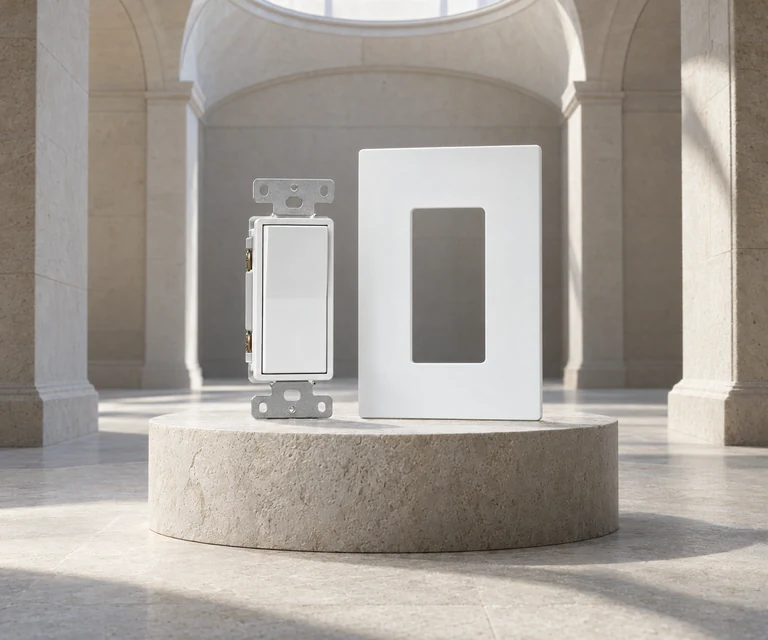
Brand hall
Legrand
From a Limoges porcelain workshop, 1865, to the wiring devices inside the wall — electrical since 1919.
Legrand · Limoges, France · est. Limoges, 1865Legrand SA · Euronext Paris, CAC 40 component
This hall documents Legrand: an 1865 porcelain tableware workshop on the Vienne at Limoges, a wiring-devices branch opened in 1919, and today a Euronext-listed group reporting €9.5 billion in 2025 sales. The exhibits keep to that record — a timeline from the riverbank works to West Hartford, an exploded receptacle read part by part, and a decoder for the spec line printed on every device face. The same markings appear on Legrand devices stocked at Super Arbor.
Wing I
The record
The register, in eight exhibits.
Exhibit 01 — 1865
A porcelain works on the Vienne
Wood merchants Henri Barjaud de Lafond and Léonard Clidasson set up a porcelain tableware workshop on the Route de Lyon in Limoges, per the group's history, sited on the Vienne river so wood for the kilns could arrive by water. The group's head office still stands on the site.
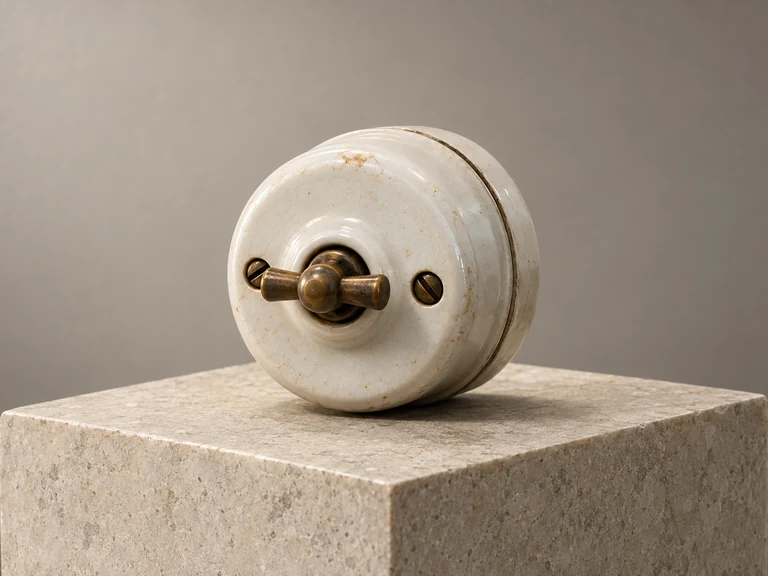
Exhibit 02 — 1904
The name arrives
Frédéric Legrand, with partners Charles Alary and Jean Joquel, bought the factory; the firm became the Legrand, Alary & Joquel Company. From then on, per the group's official history, Legrand was part of the company name.
Exhibit 03 — 1919
The electrical pivot
Partner Jean Mondot, who ran a small works at nearby Exideuil making light switches of porcelain and boxwood, opened an 'electrical wiring devices' branch. Low-voltage devices gradually became the company's main activity, per the group's history.
Exhibit 04 — 1984
Pass & Seymour joins
Legrand's first step into North America: the acquisition of Pass & Seymour of Syracuse, New York, an electrical-porcelain maker formed in 1890 by partners who judged the wooden wiring devices of the day unsafe when wet. The Syracuse line remains Legrand's professional wiring-device brand.
Exhibit 05 — 2006
Return to the Bourse
First listed on the Paris exchange in 1970, Legrand returned to public markets after a period of private ownership, listing on Euronext Paris in April 2006. In December 2011 the share joined the CAC 40 index, where it remains a component.
Exhibit 06 — 2013
adorne reaches American walls
From West Hartford, Legrand introduced adorne to US showrooms and home-improvement retailers: switches, dimmers, outlets, and wall plates, the plates offered at launch in 32 finishes spanning cast metals, natural woods, and leather, per the company's release.
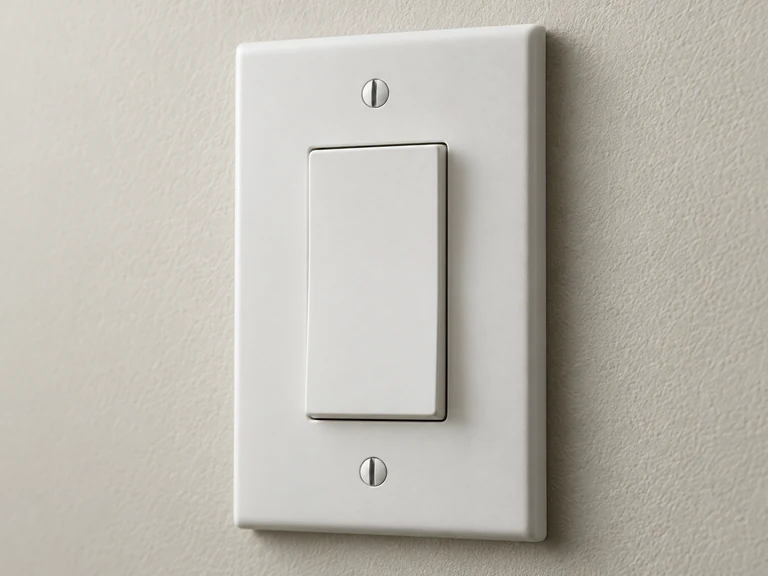
Exhibit 07 — 2018
The connected-home turn
Announced from Limoges on November 15, 2018: the acquisition of Netatmo, the French smart-home company founded in 2011. Netatmo's engineers joined Legrand's R&D teams under Eliot, the group's program for connected solutions, and founder Fred Potter became the program's chief technology officer.
Exhibit 08 — 2025
The record year
Legrand reported sales of €9,480.6 million for 2025 — record revenue growth of 13% excluding currency effects, per the group — with North and Central America contributing 42.2% of revenue. The company describes itself as 'the global specialist in electrical and digital building infrastructures.'
Interactive exhibit
One device, opened
A decorator switch, separated into the parts the spec line names. Open the numbered plates.
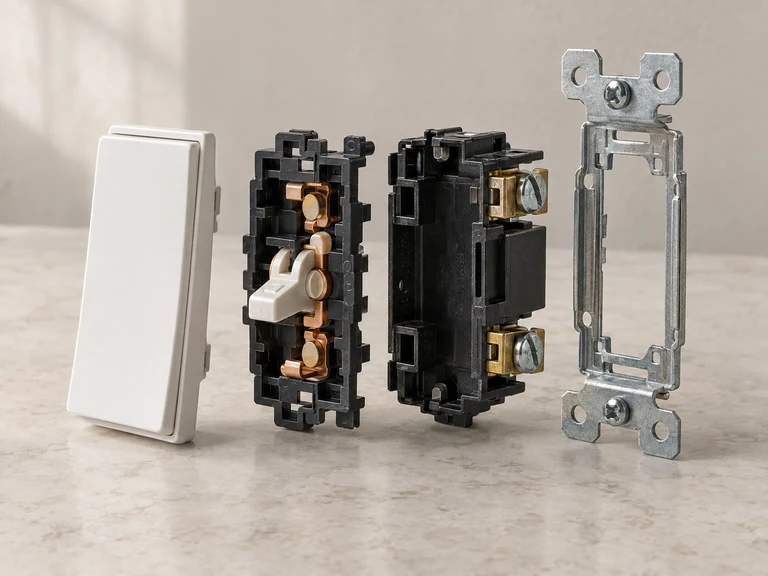
- 01
Rocker face
The broad paddle that gives decorator devices their name. Pressing it pivots the actuator that opens or closes the contacts — one motion, full travel, no toggle bat. Legrand describes its radiant paddles as modern and low-profile, with no screws in sight; the rectangular decorator opening is a shared format, so plates and devices interchange within it.
- 02
Strap, or yoke
The stamped-steel frame that carries everything: mounting ears that screw to the box, threaded holes that receive the plate. On radiant switches the strap is .042-inch zinc-plated steel and runs through the body — Legrand's spec sheet credits the extra-long strap with eliminating floating installations. When a device sits crooked or proud of the wall, the strap is usually the story.
- 03
Terminals: side-wire vs back-wire
Brass screws take the hot conductor, silver-toned screws the neutral — a color convention that runs industry-wide. Side-wiring loops the wire under the screw head; back-wiring on radiant devices clamps a straight conductor behind an external screw-pressure plate. The spec sheet accepts #14 and #12 AWG either way. Pressure-plate back-wiring is a screw clamp, distinct from spring push-in connections.
- 04
Ground screw
The green hex-head screw bonded to the strap. It lands the bare or green equipment grounding conductor, giving fault current a low-resistance path back to the panel so the breaker can open. On radiant devices Legrand specifies an easy-access green hex-head ground screw with tri-drive slots.
- 05
Wall plate
The visible layer, and the last part installed. radiant and adorne plates are screwless — no fastener heads on the face — and radiant plates come in nine colors and finishes across one- to six-gang sizes, per Legrand. The plate conceals the box opening and the strap; sizing follows the gang count of the box beneath.
Stylized CGI rendering — an illustration of a wiring device's parts, not a Legrand drawing.
The lines, explained
radiant. adorne. Pass & Seymour.
Three lines, one wall — the workhorse, the designer plate, and the spec-grade pro line. The cards keep them straight.
Decorator
radiant
Legrand's workhorse decorator line: paddle switches, dimmers, outlets, night lights, smart controls, and screwless wall plates in nine colors and finishes, per the brand's pages. Outlets use what Legrand calls patented invisi-shutters for tamper resistance; switches carry a through-body zinc-plated steel strap and take #14 or #12 AWG conductors, back- or side-wired. The format is standard decorator, so the family coordinates across a whole house.
FitsWhole-house refresh — matched devices and plates, room by room.
Designer
adorne
The design flagship, introduced to US showrooms and retailers in 2013 from West Hartford. Switches, dimmers, outlets, and wall plates — including the touch, wave-activated, and pop-out mechanisms named in the launch release — with plates offered at launch in 32 finishes spanning cast metals, natural woods, and leather, per Legrand. The line treats the switch as a design decision rather than an afterthought, in the company's telling.
FitsThe feature wall — where the plate is meant to be seen.
Spec-Grade
Pass & Seymour
The professional line. Pass & Seymour formed in Syracuse, New York in 1890 to make electrical porcelain safer than the wooden devices of the day, and joined Legrand in 1984 as its first step into North America. Today the brand spans residential, commercial, and specification-grade switches and receptacles, plus the PlugTail system that terminates wiring on a pre-wired connector instead of on-device screws.
FitsThe contractor's line — quantity, duty ratings, spec-sheet consistency.
Amp ratings are physics, not trim: a 20-amp plug's horizontal neutral blade will not enter a 15-amp receptacle, and NEC Table 210.21(B)(3) matches receptacle ratings to branch circuits — it does not list a 20-amp receptacle for a 15-amp circuit. TR shutters are a dwelling-code requirement, not an option. Every circuit-level question ends at local code.
Read the spec line
Reading a receptacle spec line
Three marks on one stocked outlet face. Each is a rating, a code requirement, or a protection class — never decoration.
15A 125V
Ampere and voltage rating
The current and voltage the device itself is rated to carry. A 20-amp receptacle is visibly different: its neutral slot gains a horizontal branch — the T-slot — to accept 20-amp plugs. NEC Table 210.21(B)(3) permits 15-amp receptacles on a 20-amp branch circuit serving two or more receptacles; a single receptacle on an individual branch circuit must be rated not less than the circuit. The governing answer is always local code.
TR
Tamper-resistant
Tamper-resistant. Spring-loaded shutters behind the slots open only when both plug blades press in simultaneously, blocking a single object a child might insert. The NEC has required listed tamper-resistant receptacles in specified dwelling locations since the 2008 edition — the requirement now sits at 406.12 — with later cycles expanding coverage. The TR mark on the face is how you confirm compliance; Legrand's radiant outlets implement it with what the brand calls invisi-shutters.
SELF-TEST GFCI
Ground-fault protection class
Ground-fault circuit interrupter, self-testing. A GFCI compares outgoing and returning current and opens the circuit at roughly 4 to 6 milliamperes of imbalance — the Class A threshold of UL 943 — protecting people from shock. An AFCI instead detects hazardous arcing, protecting the structure from fire under NEC 210.12. Dual-function devices do both; 'combination' on an AFCI means series-plus-parallel arc coverage, not a built-in GFCI.
'Decorator' names the rectangular device opening this outlet uses; 'duplex' is the traditional two-receptacle face. Where each protection type is required varies by NEC edition and jurisdiction — a licensed electrician and local code make the final call.
The desk's read
How the desk checks a device order
The order logic nobody writes down — voiced as our desk's read, not the brand's claim.
Pick the line before the finish
The desk's read: decide by room and duty, not by catalog order. radiant covers the matched whole-house refresh; adorne is the statement wall where the plate is part of the design; Pass & Seymour is the job-box line for quantity and hard use. Mixing lines mid-hallway shows — devices and plates are made to coordinate within a family, and finishes rarely translate across.
The 20-amp 'upgrade' that isn't
The desk's read: buying T-slot 20-amp receptacles for a 15-amp circuit is the classic mis-spend. The T-slot invites loads the wiring upstream was never sized for, and NEC Table 210.21(B)(3) does not list that pairing. Match the device rating to the branch circuit, and let a licensed electrician and local code settle anything that starts at the panel.
Count gangs, then buy plates
The desk's read: the money leak in a device refresh is the wall plate order. Walk the house and count openings per box — radiant plates run one to six gangs — before anything goes in the cart, and buy device and plate in the same line and finish in one pass. A returned plate order costs more time than the count would have.
First buy: one switch, one plate
The desk's read: sample before committing a house. One paddle switch or dimmer with its matching screwless plate, installed in the room you use most, tells you more about fit, feel, and finish under your own lighting than any gallery photo. Scale the order once the sample has survived a week of hands — the finish you liked on screen is the one to re-check on the wall.
Swapping switches but not sure what the box needs? Put it on a list and let a specialist read the circuit. Paste the list, however you have it
The working collection
The device bench
The working wall — dimmer, GFCI, fan control, USB.
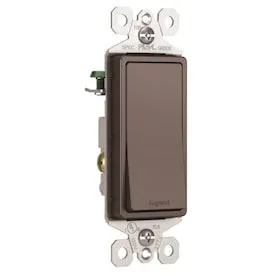
Legrand
Radiant 15-amp Single-Pole Dark Bronze Rocker Residential Light Switch
$5.29 each
Legrand
adorne Paddle 1.6 Amp 4-Speed Fan Control, Magnesium
$41.98 each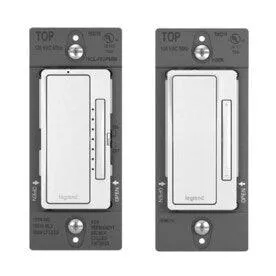
Legrand
Radiant 450-Watt Multi-Location White Illuminated Master Dimmer LED Dimmer
$49.98 each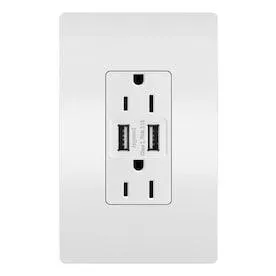
Legrand
radiant White 15-Amp Decorator Tamper Resistant with Wall Plate Residential Usb Outlet
$24.97 each

Illustrative production study, not a photograph of the maker's own facility.
Asked at the desk
Questions, answered plainly
What is the difference between a 15-amp and a 20-amp outlet?
A 15-amp receptacle has two vertical slots plus a ground hole; a 20-amp receptacle adds a horizontal branch to the neutral slot — the T-slot — so 20-amp plugs can enter. NEC Table 210.21(B)(3) permits 15-amp receptacles on a 20-amp branch circuit serving two or more receptacles, but a single receptacle on an individual circuit must be rated not less than the circuit. Confirm any specific installation against local code.
What does TR mean on an outlet?
TR marks a listed tamper-resistant receptacle. Internal spring-loaded shutters open only when both plug blades press in at the same time, blocking single objects a child might insert. The National Electrical Code has required tamper-resistant receptacles in specified dwelling locations since the 2008 edition; the requirement now appears in 406.12. On Legrand radiant outlets the mechanism is what the brand calls invisi-shutters.
Do I need GFCI or AFCI protection?
They address different hazards. GFCI protection trips at roughly 4–6 milliamperes of ground-fault current — the UL 943 Class A threshold — to protect people from shock; AFCI protection detects hazardous arcing to protect the structure from fire, under NEC 210.12. Many dwelling circuits now require one or both, and dual-function devices provide both. Which locations need which is a local-code question.
Is Pass & Seymour the same company as Legrand?
Yes. Pass & Seymour formed in Syracuse, New York in 1890 as an electrical-porcelain maker and was acquired by France's Legrand in 1984 — the group's first step into North America. It continues as Legrand's professional wiring-device brand, covering residential, commercial, and specification-grade switches and receptacles sold across North America.
What is Legrand's radiant collection?
radiant is Legrand's decorator-style line: paddle switches, dimmers, outlets, night lights, smart lighting controls, and screwless wall plates offered in nine colors and finishes, per Legrand's pages. Devices use the standard rectangular decorator form, and plates run one to six gangs, sized to the box beneath — the line is built to coordinate across a whole house.
Who owns Legrand, and where is it based?
Legrand SA is an independent public company headquartered in Limoges, France — on the site of the 1865 porcelain workshop where its story began — and is listed on Euronext Paris as a CAC 40 component. The group reported €9.5 billion in sales for 2025. Its North and Central American headquarters is in West Hartford, Connecticut.
The hall closes. The wall keeps its manners.
The Legrand lines above are live catalog — priced in the open, the same number for everyone. Devices are a fit buy: send the list — however you have it — and a human specialist checks amps, boxes, and plates before you order.
Citations: Legrand group history and investor publications (legrand.com); Legrand North America product pages and specification sheets (legrand.us); Legrand press releases, 2013–2026; ESFI, IAEI, and state electrical-board references for code context; independent corporate histories. Era and anatomy imagery: styled visualizations, not archival photographs or Legrand drawings.
Legrand®, radiant®, adorne®, Pass & Seymour®, and PlugTail® are trademarks or registered trademarks of Legrand or its affiliates. Super Arbor is an independent retailer; brand marks remain the property of their respective owners.