Brand hall
Square D
An 1836 ironworks at Le Creusot, a 1902 fuse shop in Detroit — one square-D mark on the panel door.
Schneider Electric · Rueil-Malmaison · est. Le Creusot, 1836Euronext Paris: SU · Square D in the group since 1991
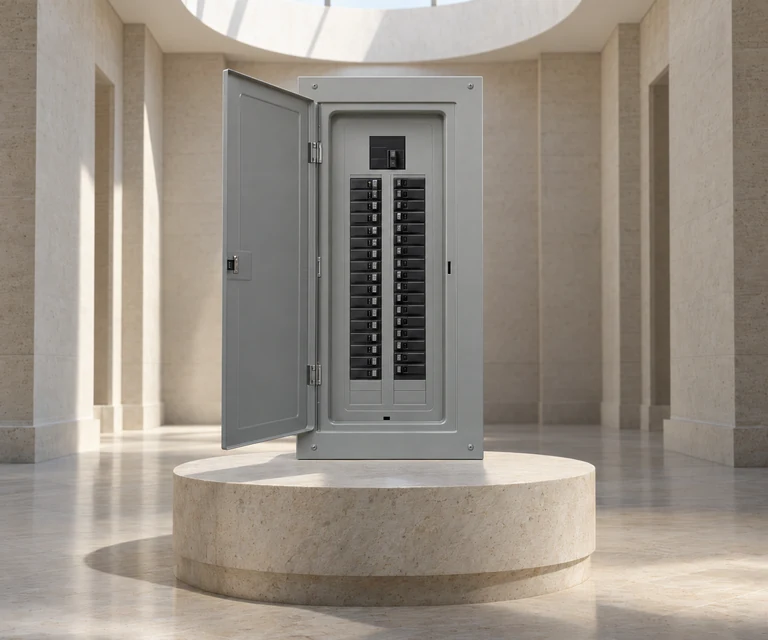
Two records merge in this hall: Schneider, the French ironworks that took over Le Creusot in 1836 and entered the electricity market in 1891, and Square D, the Detroit fuse company whose stamped logo became its name. Their shared North American legacy is the residential load center — and the two breaker systems, QO and Homeline, that fill it. The exhibits trace both lineages, open a panel down to its bus bars, and teach the catalog grammar printed on every breaker stocked at Super Arbor.
Wing I
The record
The register, in eight exhibits.
Exhibit 01 — 1836
The Le Creusot works
Brothers Adolphe and Joseph-Eugène Schneider take over the Le Creusot foundry in Burgundy, France. Schneider & Cie builds its base in iron, steel, and heavy machinery — the industrial footing from which the group's electrical business later grows.
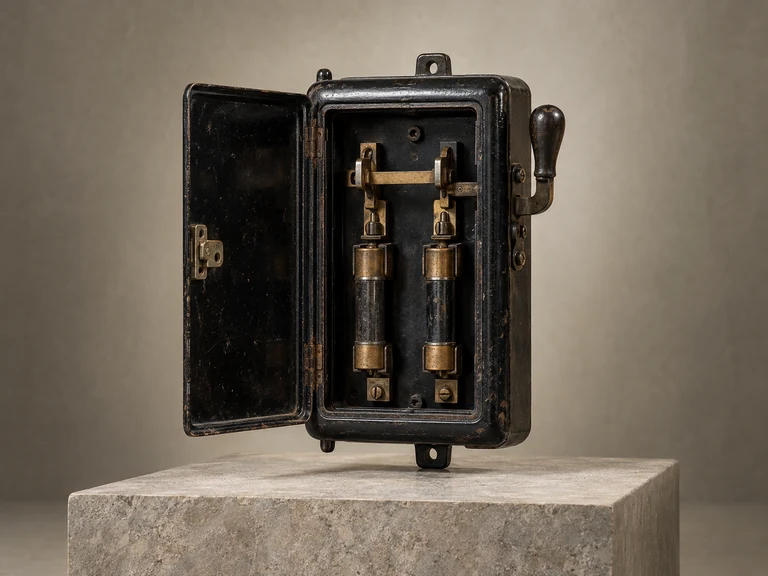
Exhibit 02 — 1891
Into electricity
An armaments and steel specialist by its second generation, Schneider enters the emerging electricity market. In the years that follow it manufactures electric motors, power-station equipment, and electric locomotives, working for a period with Westinghouse to broaden its electrical range.
Exhibit 03 — 1902
A Detroit fuse shop
On December 15, 1902, Bryson D. Horton and James B. McCarthy form a fuse company in Detroit; a staff of two assembles the first order of 1,000 cartridge fuses. The firm is renamed Detroit Fuse and Manufacturing in 1908.
Exhibit 04 — 1917
The mark becomes the name
A capital D for Detroit inside a square, stamped on the company's enclosed switches, becomes how customers ask for the product. The company trademarks the mark and takes the name: Square D.
Exhibit 05 — 1955
QO arrives
Schneider Electric dates its QO offer to 1955. The company's own brochure records that QO load centers and circuit breakers "changed the way homes were protected," replacing standard fuses with its patented Qwik-Open technology; today's QO breakers keep the line's space-saving ¾-inch format.
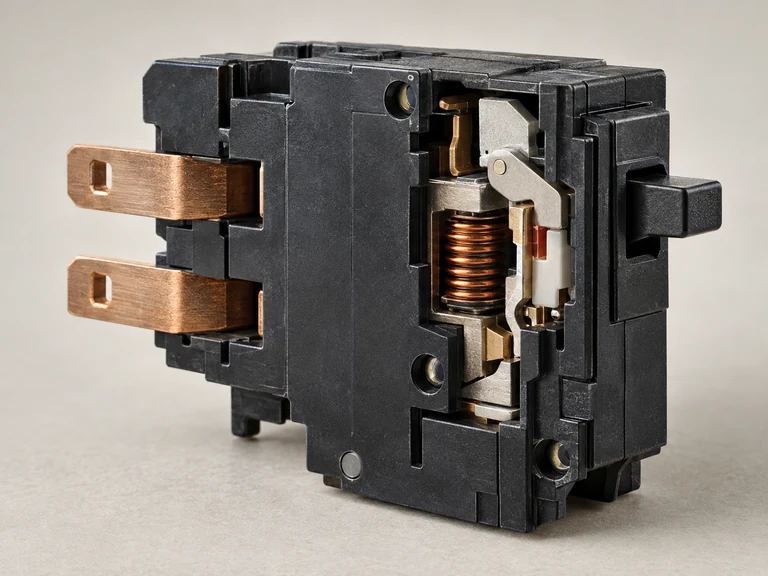
Exhibit 06 — 1991
Square D joins Schneider
Groupe Schneider, refocused on the electrical sector after acquiring Telemecanique in 1988, acquires Square D for $2.23 billion; Merlin Gerin is fully absorbed in 1992. Square D continues as the group's North American electrical-distribution brand.
Exhibit 07 — 1999
Schneider Electric
In May the group renames itself Schneider Electric, marking its concentration on the electrical field. The Square D mark stays on the residential load centers, breakers, and switches it sells across North America.
Exhibit 08 — 2026
The listed group
Schneider Electric SE trades on Euronext Paris (ticker SU) from Rueil-Malmaison, France, and reports €40.2 billion in FY2025 revenues per its February 2026 results release. QO and Homeline continue under the Square D brand.
Interactive exhibit
One breaker, opened
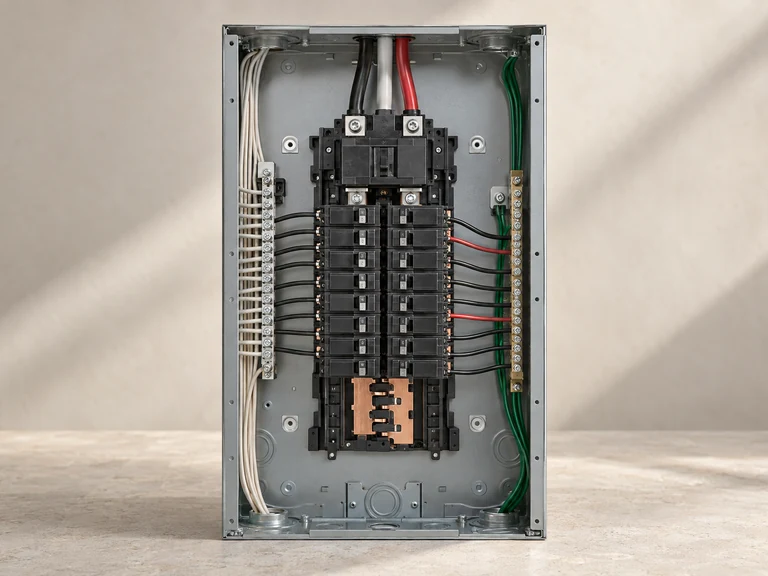
A plug-on breaker over its panel interior, separated into the parts the catalog number describes. Open the numbered plates.
- 01
Interior bus assembly
The spine of the panel. QO interiors carry a one-piece, electro tin-plated copper bus — in the QO design, sandwiched between two polymer shields that reduce the chance of accidental contact. Homeline interiors run tin- and copper-plated aluminum bus bars. Every branch breaker in the panel takes its power from connectors on these bars.
- 02
Plug-on breaker
No bolts hold a Square D branch breaker in place. The wire-terminal end seats on the mounting rail; the breaker rotates inward until its plug-on jaw fully engages the bus bar connector — the exact motion Schneider's instruction bulletin specifies. On QO models, a red Visi-Trip window signals a tripped breaker at a glance.
- 03
Neutral bar
Where every circuit's white conductor lands, on backed-out screws set for straight-in wiring. Plug-on Neutral interiors distribute the bar beside the bus so CAFI and dual-function breakers connect without a pigtail. The green bonding screw joins neutral to enclosure only where local code requires it.
- 04
Equipment ground bar
A separate bar terminates the equipment grounding conductors. Schneider's bulletin directs the installer to connect the service ground, the equipment grounding wire, or both as required by local electrical code — and to torque every neutral and ground connection to the value on the wiring diagram fastened inside the enclosure.
- 05
Cover and trim
The deadfront layer that leaves only breaker handles exposed. Twistouts come out to match the breakers installed; unused openings must be filled with filler plates; trim screws torque to 20 pound-inches. QO covers are automatic flush-adjusting, and Homeline flush covers ride a floating, spring-mounted trim.
Stylized CGI rendering — an illustration of breaker-and-panel parts, not a Square D drawing.
The platforms, explained
QO. Homeline. The protectors.
Square D's two residential systems — three-quarter inch and one inch — and the protective breakers both take. They never interchange.
¾ in
QO
The premium plug-on line — per Schneider Electric, its industry-leading offer since 1955. QO breakers use a space-saving ¾-inch format, patented Qwik-Open overload and short-circuit technology, and the exclusive red Visi-Trip indicator that flags a tripped breaker. QO load centers pair them with a shielded, one-piece tin-plated copper bus, with Plug-on Neutral interiors on 12 spaces and above. Standard, CAFI, GFI, and dual-function versions share one catalog grammar.
FitsPanels whose label reads QO — and only those.
1 in
Homeline
Square D's value line — "engineered for value" in Schneider Electric's words — built on a 1-inch breaker format. Homeline load centers carry tin- and copper-plated aluminum bus bars, fully convertible mains for top or bottom feed, and a Plug-on Neutral solution with a fully distributed neutral bar on 8-space-and-larger enclosures. Its breakers cover the same protection classes as QO, inside Homeline enclosures only.
FitsValue-driven builds on panels labeled HOM.
AFCI/GFCI
Protective breakers
Both lines carry the advanced-function family. CAFI combination arc-fault interrupters help protect against fire-starting arc faults; GFI breakers provide Class A ground-fault protection; dual-function (DF) breakers combine both technologies in a single device. The suffix names the job — QO120CAFI, HOM230GFI, HOM120DF — and the prefix still names the panel. Which circuits require them is a local-code question.
FitsCircuits your local code designates for arc- or ground-fault protection.
Series must match panel. Square D load centers are UL-listed to accept only the breakers marked on their label, and per Schneider Electric, QO and Homeline are not interchangeable — QO breakers cannot be used in Homeline load centers, nor Homeline in QO. Any other use voids the warranty and may reduce protection and violate the National Electrical Code.
Read the number
Reading a Square D catalog number
Series, poles, amperes, protection — one string on every breaker toggle. The grammar below is verified against Schneider Electric's own listings.
QO
Series — the panel system
The prefix names the breaker system, and the system is a commitment. QO is the ¾-inch premium line; HOM is the 1-inch Homeline value line. Schneider Electric's support FAQ states it without qualification: the two are not interchangeable — QO branch breakers cannot be used in Homeline load centers, and Homeline breakers cannot be used in QO. Read the prefix against the panel label before anything else.
120
Poles + ampere rating
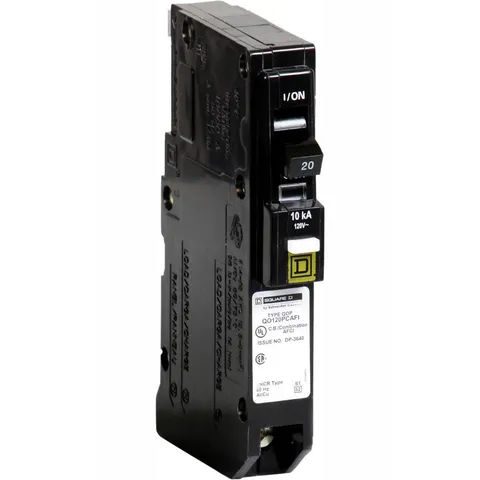
First digit, number of poles; remaining digits, ampere rating. QO120 is a 1-pole 20 A breaker rated 120/240 VAC with 10 kA interrupting capacity, per Schneider Electric's listing; HOM230 is a Homeline 2-pole 30 A on the same pattern. Two-pole breakers take two spaces and serve 240 V circuits. The rule holds across both series, so the middle digits read the same on any shelf.
CAFI
Function suffix
No suffix means a standard thermal-magnetic breaker. CAFI marks a combination arc-fault interrupter; GFI marks Class A ground-fault protection; DF marks a dual-function breaker combining both. All three appear in current catalogs — QO120CAFI, HOM230GFI, HOM120DF. Retail packaging can append a further C or CP to the same electrical rating, so match the base number, not the box.
QO120 and HOM120 describe the same 1-pole, 20 A rating in two systems that do not interchange. A VH suffix on QO denotes a 22 kA interrupting rating (QO120VH, per Schneider Electric's listing).
The desk's read
How the desk checks a panel order
The order logic nobody writes down — voiced as our desk's read, not the brand's claim.
Panel first, breaker second
The desk's read: the label inside the panel door is the only shopping list that matters. It names the breakers the load center is listed to accept — QO panels take QO, Homeline panels take HOM, and Schneider's FAQ closes the loophole on mixing. Photograph the label and wiring diagram before you order; every question the desk will ask is printed there.
The two-dialect trap
The desk's read: QO120 and HOM120 look like the same breaker written twice — same poles, same amps — and that resemblance is where returns come from. The prefix is the whole difference: one plugs onto a QO bus, the other onto Homeline, and neither seats in the other's panel. Check the letters ahead of the numbers against the panel label before buying multiples.
Price the protection schedule
The desk's read: price the protection schedule before the enclosure. Count the circuits local code designates for arc-fault protection, ground-fault protection, or both; that count — CAFI, GFI, and DF breakers ordered per circuit — defines the job more than the box does. A standard breaker and its protective sibling share the same pole-and-ampere digits, so a circuit list converts straight into catalog numbers.
First panel buy
The desk's read: order the load center and every breaker as one series in one order. Mind spaces versus circuits — tandem breakers install only in panels marked for them, per Schneider's bulletin. If the schedule carries CAFI or dual-function breakers, a Plug-on Neutral interior connects them without pigtails. And keep filler plates on the list; unused openings must be covered before the panel closes up.
A photo of the panel door on a list beats a guess — a specialist reads QO or HOM off the label before you order. Paste the list, however you have it
The working collection
The panel bench
Load centers and mains — both families, clearly marked.
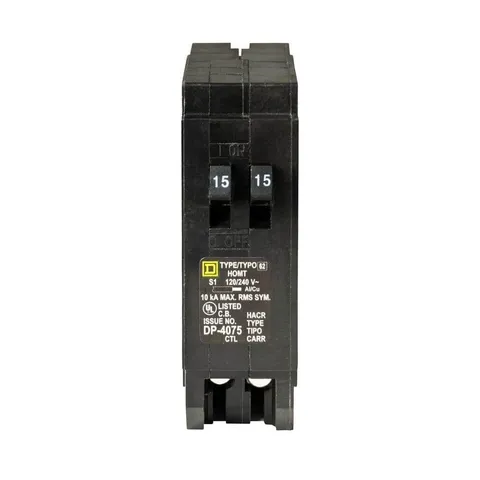
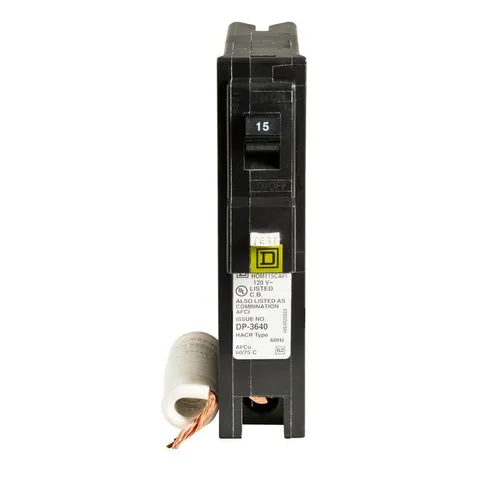
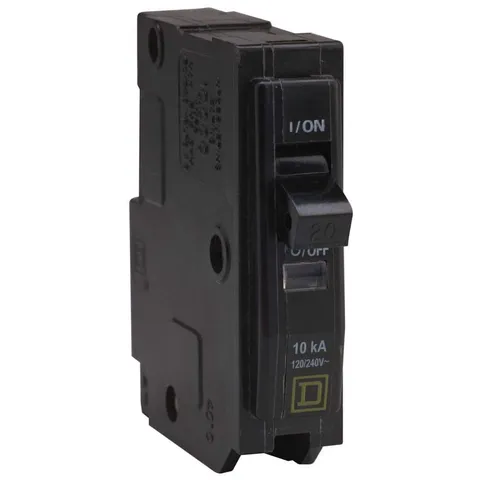
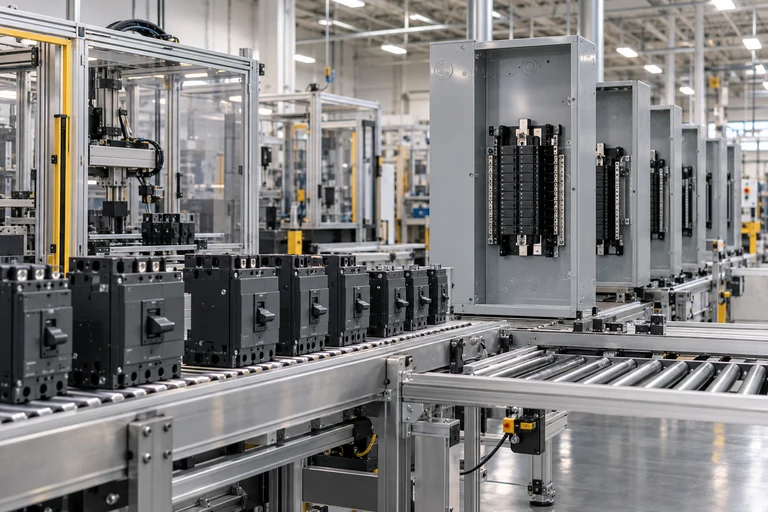
Illustrative production study, not a photograph of the maker's own facility.
Asked at the desk
Questions, answered plainly
What does QO mean on Square D breakers?
QO is Square D's Qwik-Open breaker line: Schneider Electric's brochure credits its "patented Qwik-Open technology" with replacing home fuses when the line launched, and Schneider dates the QO offer to 1955. QO breakers use a ¾-inch format and a red Visi-Trip window that shows when the breaker has tripped.
Are Square D QO and Homeline breakers interchangeable?
No. Schneider Electric's support FAQ states that QO and Homeline are not interchangeable: QO branch circuit breakers cannot be used in Homeline load centers, and Homeline branch breakers cannot be used in QO load centers. The series printed on the breaker must match the series on the load-center label.
What is the difference between QO and Homeline?
Format and construction. QO is Square D's premium ¾-inch breaker line with Visi-Trip indication; QO load centers use a shielded, tin-plated copper bus. Homeline is the 1-inch line Schneider Electric describes as engineered for value; its load centers use tin- and copper-plated aluminum bus bars. Both are UL-listed plug-on systems with standard, arc-fault, ground-fault, and dual-function breakers.
What do catalog numbers like QO120 and HOM230 mean?
The letters name the series, the first digit the poles, the remaining digits the ampere rating. QO120 is a QO-series 1-pole 20 A breaker (120/240 VAC, 10 kA); HOM230 is a Homeline 2-pole 30 A. Suffixes add protection class: CAFI for combination arc fault, GFI for Class A ground fault, DF for dual function combining both.
Can I install another brand's breaker in a Square D panel?
Schneider Electric says no. Its FAQ states that Square D QO and Homeline load centers are UL tested, listed, and labeled to accept only Square D circuit breakers, and that other manufacturers' breakers void the product's UL listing and warranty. The accepted breakers are printed on the panel's label and wiring diagram.
Who owns Square D?
Schneider Electric, the Euronext Paris–listed group (ticker SU) headquartered in Rueil-Malmaison, France. Square D began in Detroit in 1902 as a fuse maker, took its name from the D-in-a-square mark in 1917, and was acquired by Groupe Schneider in 1991. Residential products now sell as Square D by Schneider Electric.
The hall closes. The square mark stays on the door.
The Square D lines above are live catalog — priced in the open, the same number for everyone. Electrical is a match buy: send the panel label — a photo works — and a human specialist confirms family, spaces, and amps before you order.
Citations: Schneider Electric corporate history and brand pages (se.com) · Square D QO and Homeline range pages and product listings (se.com) · Schneider Electric brochure 1100BR1201 (2013) and instruction bulletin S1B33894 · Schneider Electric FY2025 results release · Euronext Paris · independent record: Tampa Bay Times (1991), Encyclopedia.com, Control Engineering, Wikipedia. Era and anatomy imagery: styled visualizations, not archival photographs or Schneider Electric drawings.
Schneider Electric, Square D, QO, Homeline, Visi-Trip, Qwik-Open, and Qwik-Gard are trademarks owned by Schneider Electric Industries SAS or its affiliated companies; all other trademarks are the property of their respective owners. Super Arbor is an independent retailer; brand marks remain the property of their respective owners.