
Johns Manville has been making building materials since before the light bulb — roofing first, then the insulation lineage the name is known for. This hall is the record, the families of insulation explained, how to read the label on a bag, and the answers our desk gives every day. Every fact carries its source.
Wing I
The record
One hundred sixty-seven years, in eight exhibits.
Exhibit 01 — 1858
A roofing company is born in New York
Henry Ward Johns founds the H.W. Johns Manufacturing Company in New York City, making roofing materials. By JM's own telling, the first shingle was made by applying hot tar to cloth with a clothes wringer and a household tea kettle.
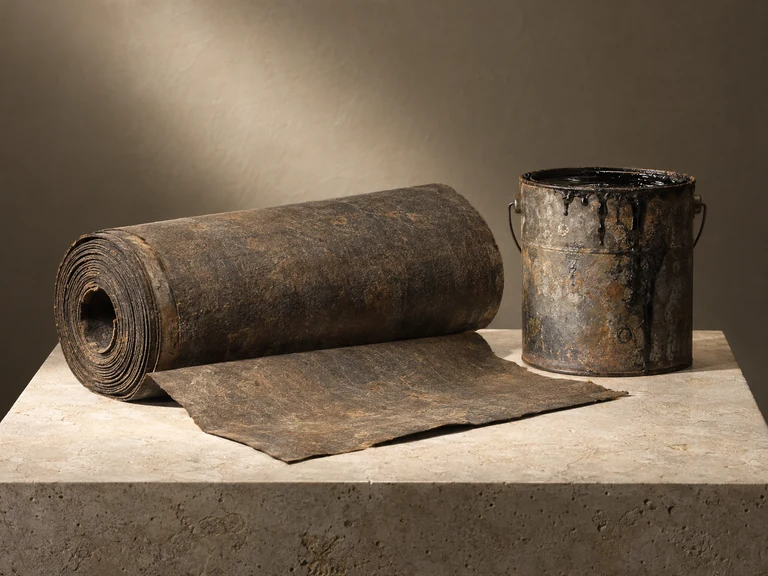
Exhibit 02 — 1886
Manville Covering Company, Milwaukee
Charles B. Manville establishes the Manville Covering Company in Milwaukee, Wisconsin, making pipe coverings and insulation for the steam-powered industry of the age.
Exhibit 03 — 1901
Johns meets Manville
H.W. Johns Manufacturing and the Manville Covering Company merge to form the H.W. Johns-Manville Company — East Coast roofing manufacture joined to Midwestern insulation expertise. JM's official timeline dates the merger to 1901.
Exhibit 04 — 1958
Entering the fiber glass era
A century after its founding, Johns-Manville enters the fiber glass business by purchasing L.O.F. Glass Fibers of Ohio — the root of the fiberglass insulation lineage the brand is known for today.
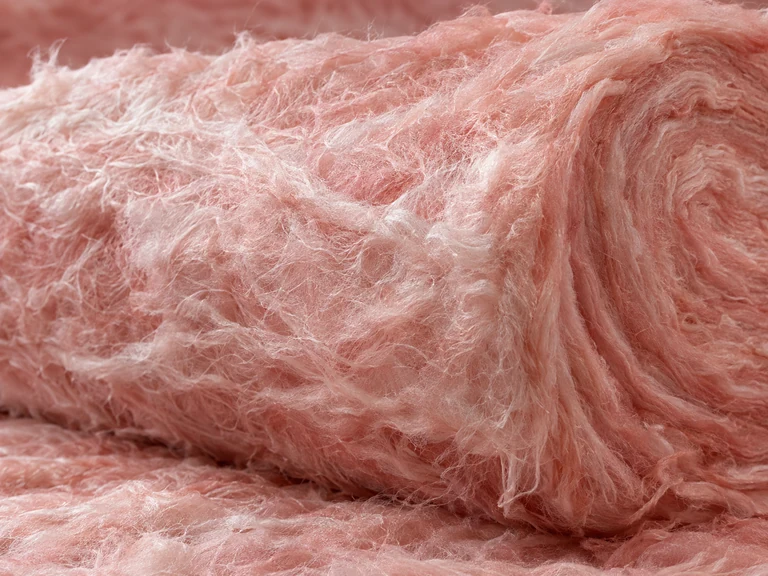
Exhibit 05 — 1972
Denver, and a home for R&D
Johns-Manville moves its world headquarters from New York to Denver, Colorado, and opens the Johns Manville Technical Center in Littleton — a dedicated research and development campus.
Exhibit 06 — 1997
The name restored
Following a corporate reorganization in the 1980s — a Chapter 11 filing in 1982 and emergence in 1988 — the company returns to the Johns Manville name in 1997.
Exhibit 07 — 2001
Joining Berkshire Hathaway
Berkshire Hathaway completes its all-cash tender offer of $13.00 per share and acquires Johns Manville on February 27, 2001. Warren Buffett called it "the opportunity to own a company with such strong market positions, leadership, and financial performance."
Exhibit 08 — 2002
The binder switch — Formaldehyde-Free
In March 2002, Johns Manville becomes — per JM — the first fiberglass insulation manufacturer to stop using a formaldehyde-based binder in its building insulation, switching to an acrylic binder, with all plants converted by that August. Today, per JM, its fiberglass building insulation ships Formaldehyde-Free.
Interactive exhibit
One wall, opened
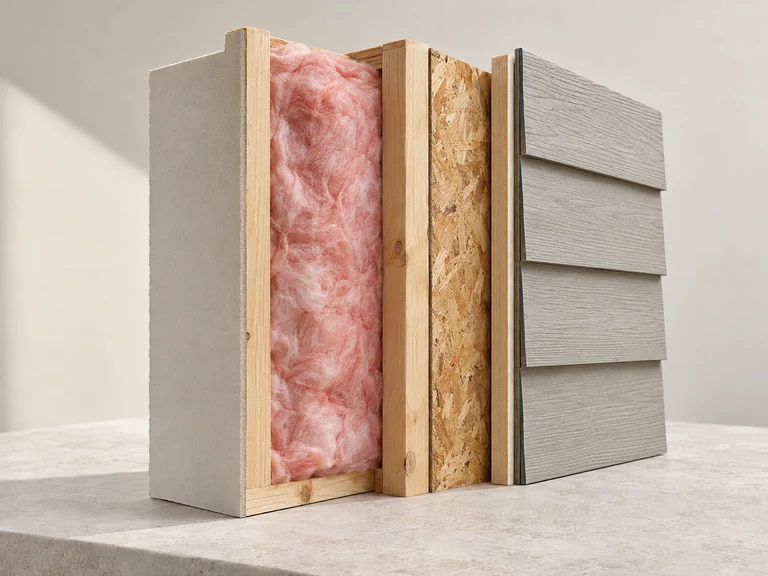
A framed wall, separated into the layers you are actually buying. Open the numbered plates.
- 01
The unbroken layer
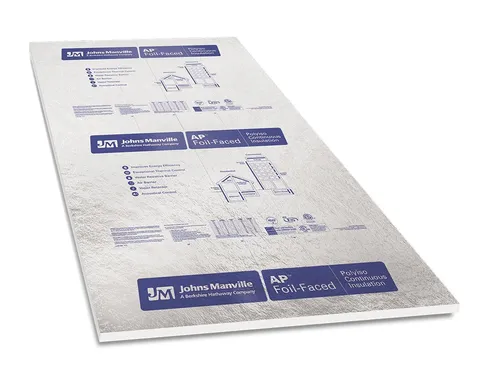
Rigid polyiso is the continuous-insulation family: closed-cell foam bonded to foil facers, made to sheathe framing in one unbroken thermal layer. The stocked AP Foil board is rated R-6.0 at one inch — and per JM's product copy, properly installed it also functions as a water-resistive, vapor, and air barrier.
- 02
The batt in the bay
Fiberglass insulation is spun glass — molten glass drawn into fine fibers that trap still air, and trapped air slows heat flow. Batts come pre-cut for standard stud bays; rolls run continuous; blown-in loose fill covers attic floors and irregular cavities.
- 03
Why 15¼ inches
Studs sit 16 or 24 inches on center — batt widths follow: 15 and 15¼ inches for 16-inch framing, 23 for 24-inch, sized to sit snug in the cavity between studs, not across them. Width, not R-value, decides whether a batt fits the wall.
- 04
Which way the paper faces
Kraft paper is a vapor retarder. JM's installation instructions place it toward the living space — the warm-in-winter side — "unless building codes specify otherwise." Unfaced batts go where no retarder is wanted: layered over existing attic insulation, or in interior sound walls.
- 05
Behind the drywall — stone, spun
Mineral wool is stone made fiber — volcanic rock, melted and spun into inorganic strands. Per JM's SAFB documentation: noncombustible, melting point above 2,000°F, flame spread and smoke developed indexes of 0, and wall-assembly STC improvements of up to 10 dB.
Stylized CGI rendering — an illustration of wall-assembly layering, not a JM drawing.
The families, explained
Three materials. One question — what's the job?
JM's homeowner line spans fiberglass, mineral wool, spray foam, and foam board. Super Arbor stocks three of the four; the desk quotes the rest.
Glass
Fiberglass — spun glass, trapped air
Fiberglass insulation is spun glass — molten glass drawn into fine fibers that trap still air, and trapped air slows heat flow. It ships three ways: batts pre-cut for standard stud bays, rolls that run continuous, and blown-in loose fill for attic floors and irregular cavities. Johns Manville was the first fiberglass insulation manufacturer to stop using a formaldehyde-based binder in its building insulation (March 2002) — per JM.
FitsFramed cavities on a budget — batts, rolls, blown-in.
Stone
Mineral wool — stone, spun
Mineral wool is stone made fiber — volcanic rock, melted and spun into inorganic strands. Super Arbor stocks JM's line as the Mineral Wool Sound Attenuation Fire Batt (SAFB). Per JM's SAFB documentation: noncombustible, melting point above 2,000°F, flame spread and smoke developed indexes of 0, and wall-assembly STC improvements of up to 10 dB.
FitsWhere sound or fire leads the spec.
R-6/in
Foam board — the unbroken layer
Rigid polyiso is the continuous-insulation family: closed-cell polyisocyanurate foam bonded to foil facers, made to sheathe framing in one unbroken thermal layer. The stocked AP Foil board is rated R-6.0 at one inch. Per JM's product copy, when properly installed it also functions as a water-resistive barrier, vapor barrier, and air barrier.
FitsContinuous insulation outside the framing, over the studs.
Compressed insulation will not deliver its full rated R-value — DOE guidance. Buy the thickness the cavity actually takes; an R-19 batt crammed into a 2×4 wall is money spent on R you will not get.
Read the label
How to read an insulation bag
Every bag tells you three things — the R, the width, and the coverage. Read it right and the wall fits on the first order.
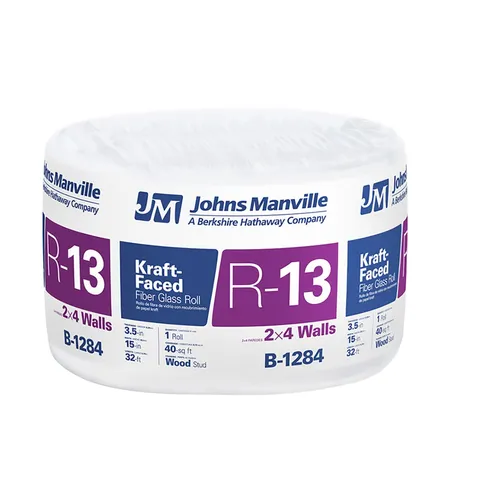
R-13
The R-value
R-value measures resistance to conductive heat flow. Since 1979 the FTC's R-value Rule (16 CFR Part 460) has required standardized testing behind every number printed on a bag — and dictates the label's one-line translation, verbatim: "R means resistance to heat flow. The higher the R-value, the greater the insulating power."
15¼″
The width
Standard framing sets studs 16 or 24 inches on center. Batt widths follow: 15 and 15¼ inches for 16-inch framing, 23 inches for 24-inch — sized to sit snug in the cavity between the studs, not across them. Measure your stud spacing before you order.
108 ft²
The coverage
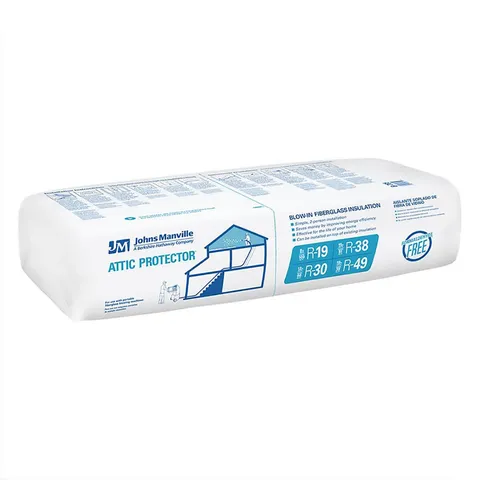
The bag is the unit — federal rule requires batt packages to state the square feet inside, and blown-in bags to chart coverage at standard R-values. Area ÷ coverage per bag = the order. Blown-in moves with depth: one Attic Protector bag covers 109 sq ft at R-19; deeper targets take more bags, per the bag's chart.
Kraft facing is a vapor retarder — JM's instructions place it toward the living space "unless building codes specify otherwise." Unfaced is for layering over existing insulation and for sound walls. Local code has the final word.
The desk's read
How the desk checks an insulation order
The order logic nobody writes down — voiced as our desk's read, not the brand's claim.
Let the job pick the family
Framed cavities on a budget — order fiberglass; batts for stud bays, blown-in for the attic. Sound or fire leading the spec — order mineral wool. Continuous insulation outside the framing, over the studs — order foam board. Thickness is a code question: check local code and the DOE climate-zone tables before you buy.
Compression costs R
The trapped air does the insulating — fiberglass is millions of still-air pockets held in glass fiber, and DOE guidance is blunt: compressed insulation will not deliver its full rated R-value. Buy the thickness your cavity actually takes. An R-19 batt crammed into a 2×4 wall is money spent on R you will not get.
Three ways orders go wrong
Width bought against R-value instead of framing — measure stud spacing; 15¼-inch batts for 16-inch centers, 23-inch for 24. Ordering by R alone — two bags with the same R can cover very different square footage, so divide your area by the coverage printed on the bag. And layering faced batts in an attic — a second layer goes unfaced, run crosswise over the first, per standard guidance. Order the boring way: spacing, area, facing — then R.
The kit for the itch
JM's installation instructions list it: safety glasses with side shields, leather or cotton gloves, a cap, a loose-fitting long-sleeved shirt, and long pants. A NIOSH-certified N95 respirator is listed as optional — required where dust or fiber levels exceed exposure limits. Wash exposed skin with soap and water when you finish. The desk's read: wear all of it, respirator included.
Measured the walls but not sure what fits? Put it on a list and let a specialist run the math. Paste the list, however you have it
The working collection
The wall bench
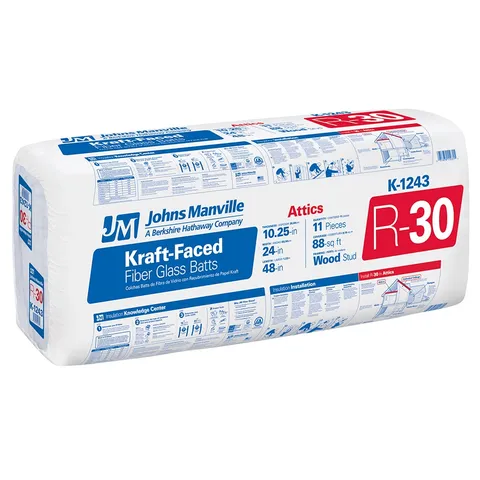
Stud-bay insulation — glass and stone — priced in the open, the same number for everyone.
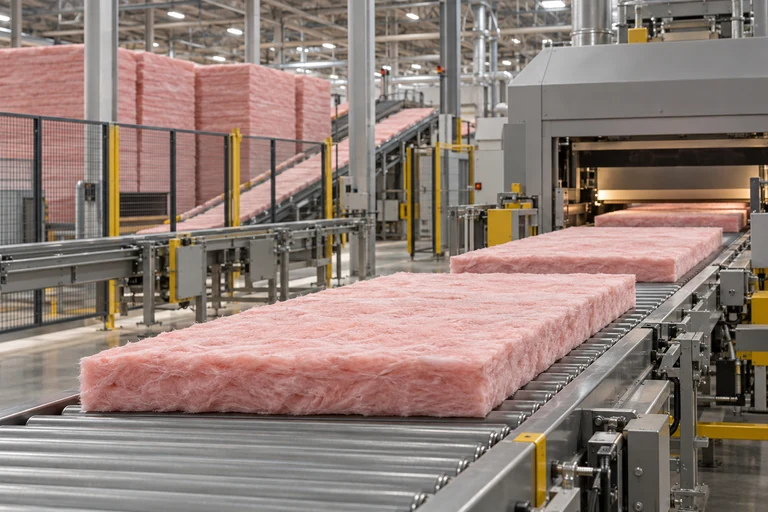
Illustrative production study, not a photograph of the maker's own facility.
Asked at the desk
Questions, answered plainly
What does R-value actually mean?
Federal law fixes the definition. The FTC's R-value Rule requires this exact line on insulation labels: "R means resistance to heat flow. The higher the R-value, the greater the insulating power" (16 CFR 460.12). The number comes from standardized testing, so an R-21 Unfaced Batt resists heat flow more than an R-13 Kraft-Faced Fiberglass Batt regardless of brand. R-value is the comparison; thickness and material are how you get there.
Why are insulation batts 15 inches wide instead of 16?
Framing is measured center to center. Studs set 16 inches on center leave a cavity of roughly 14-1/2 inches between them; a 15-inch batt is deliberately a touch wide, so friction holds it snug against both studs. Johns Manville's sizing guidance: 15-inch insulation for 16-inch on-center framing, 23-inch for 24-inch on-center. That is why the R-21 Unfaced Batt measures 15 in × 93 in — sized to the cavity, not the tape-measure spacing.
Kraft-faced or unfaced — and which way does the facing go?
The kraft paper is a vapor retarder. JM's installation instructions place it toward the living space — the warm-in-winter side — "unless building codes specify otherwise," so confirm with local code before drywall goes up. JM also advises against stacking faced products: two vapor retarders can trap moisture between layers. For layering over existing insulation, interior partitions, or sound work, use unfaced — the R-21 Unfaced Batt, or the Mineral Wool Sound Attenuation Fire Batt SAFB.
Can I squeeze thicker insulation into a smaller cavity for more R?
No. Squeezing a batt raises its R per inch but lowers its total R — the label value assumes full loft. NAIMA's industry chart puts an R-19 batt, made for a 6-1/4-inch cavity, at about R-18 in a 5-1/2-inch cavity and R-14 in a 4-inch one. JM's instructions repeat the point: avoid compressing the material, because compression will reduce its R-value. Match the batt to the cavity — R-13 for 2x4 walls, R-21 for 2x6.
How many bags do I need?
Order by the label: area divided by the bag's printed coverage, rounded up. Federal rule puts a coverage chart on every loose-fill bag (16 CFR 460.12). Batts are flat math — the R-13 Kraft-Faced Fiberglass Batt covers 108.33 sq ft. Blown-in moves with depth: one Attic Protector bag covers 109 sq ft at R-19, less as target R climbs, so read the chart at your R. The desk's read: send your measurements through send-a-list; we check the math before you order.
Do I need protection to install fiberglass?
JM's installation instructions list the kit: safety glasses with side shields, leather or cotton gloves, a cap, a loose-fitting long-sleeved shirt, and long pants. A NIOSH-certified N95 (or higher) respirator is listed as optional — and required where dust or fiber levels exceed exposure limits. Wash exposed skin with soap and water when you finish — also JM's line. The desk's read: wear all of it, respirator included, and skip the itch.
Is JM fiberglass insulation formaldehyde-free?
Yes — per JM. Johns Manville describes itself as the first fiberglass insulation manufacturer to stop using a formaldehyde-based binder in its building insulation (March 2002), with all of its plants converted by that August, and its fiberglass building insulation ships Formaldehyde-Free today, by JM's own account. Context from JM's 2024 blog: the rest of the fiberglass industry in the U.S. and Canada had phased out formaldehyde binders by 2015. First, not only — the distinction is a head start, not exclusivity.
The hall closes. The heat still moves.
The JM lines above are live catalog — priced in the open, the same number for everyone. Insulation is a coverage buy: send the list — however you have it, and a human specialist prices every line and checks the math.
Timeline and facts: Johns Manville corporate history and blogs (jm.com), JM product pages, data sheets and installation instructions, Berkshire Hathaway press releases, the FTC R-value Rule (16 CFR Part 460), DOE/ENERGY STAR and NAIMA guidance. JM self-descriptions are quoted with attribution. Era and anatomy imagery: styled visualizations, not archival photographs or JM drawings.
Johns Manville, JM, Attic Protector, MinWool, AP Foil, and Formaldehyde-Free are trademarks of Johns Manville or its affiliates. Super Arbor is an independent retailer; brand marks remain the property of their respective owners.