This hall keeps the record of a company built on an accident: an experiment with glass building blocks that, in the company's own telling, revealed a way to make glass fibers in commercial quantities. Owens-Illinois and Corning Glass Works incorporated the venture in 1938 and based it in Toledo, Ohio. The exhibits trace fiberglass from war production to PINK batts and Duration shingles, teach you to read an insulation label the way the desk does, and end at the three businesses Owens Corning runs today: roofing, insulation, and doors.
Wing I
The record
The register, in eight exhibits.
Exhibit 01 — 1930s
The glass-block accident
An experiment with glass building blocks produced an unexpected result — it revealed a way to make glass fibers in commercial quantities, per Owens Corning's own telling. Owens-Illinois and Corning Glass Works pooled the research that followed, betting on glass fiber as an insulation material.
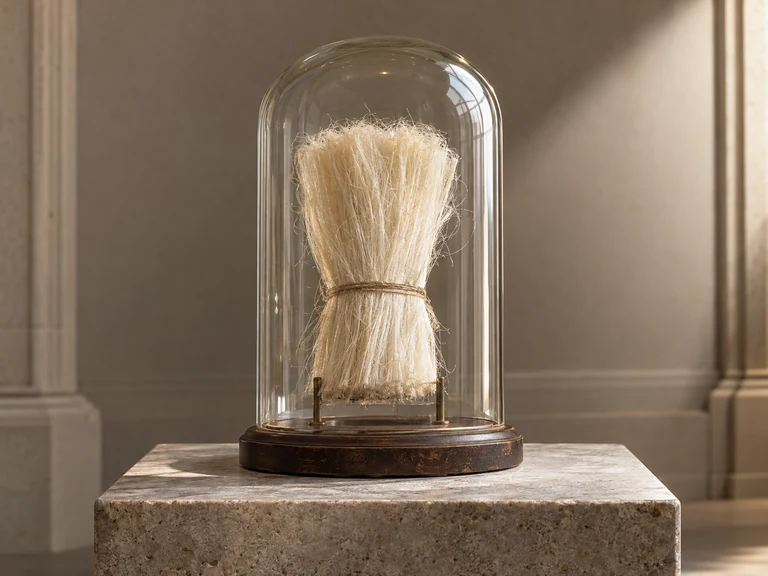
Exhibit 02 — 1938
Spun off, based in Toledo
On October 31, 1938, Owens-Illinois and Corning Glass spun off and incorporated Owens-Corning Fiberglas Corporation, based in Toledo, Ohio. The world headquarters remains in Toledo today.
Exhibit 03 — 1940s
War production
With basic materials in short supply, the young company developed Navy Board — a lightweight, nonflammable insulation with a finished wall surface — in 1939, and it remained the main product throughout World War II. In 1944 the first boat hull was made of fiberglass-reinforced plastic, opening what became one of the largest applications for glass fiber, per the company's account.
Exhibit 04 — 1955
The inaugural Fortune 500
When Fortune published its first 500 ranking in 1955, Owens-Corning Fiberglas held a place on it — a fact the company still cites. Fortune's own company profile calls the company a mainstay of the ranking every year since the list launched.
Exhibit 05 — 1977
Into roofing
Owens Corning acquired an asphalt shingle and roofing manufacturer and converted shingle production to its own glass-fiber mat — joining the company's two materials, asphalt and glass, in one product. Roofing remains one of its principal segments today.
Exhibit 06 — 1980
The Pink Panther signs on
On August 15, 1980, Owens Corning began licensing MGM's Pink Panther to front PINK Fiberglas insulation — a pairing suggested by Roger Butler of the Ogilvy & Mather agency. The silent cat has represented the brand ever since; both companies marked forty years together in 2020.
Exhibit 07 — 1987
A color on the register
The U.S. Patent and Trademark Office registered the color PINK to Owens Corning on May 12, 1987. The company describes itself as the first to receive a trademark for a color; its product data sheets still print the registration line today.
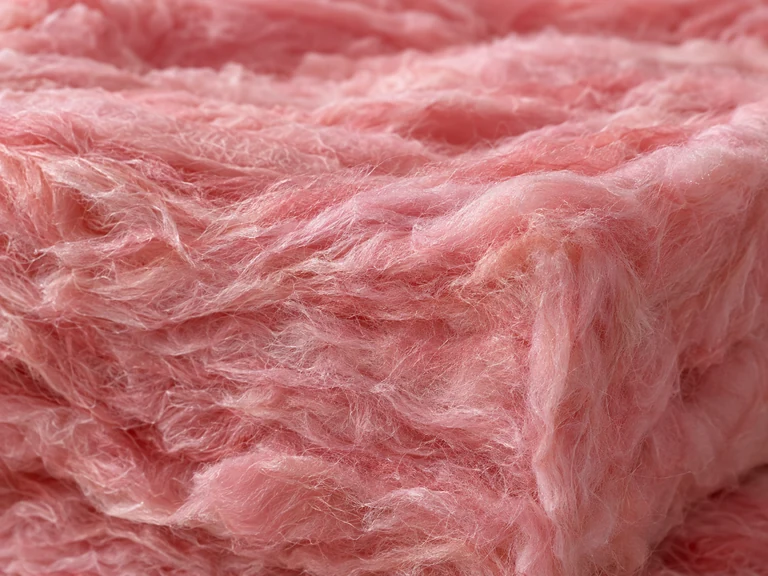
Exhibit 08 — 2024
Roofing, insulation, doors
After a Chapter 11 reorganization from 2000 to 2006, Owens Corning rebuilt around building products: it completed the roughly $3.9 billion acquisition of door maker Masonite in May 2024 and closed the sale of its glass-reinforcements business to Praana Group in May 2026, leaving three segments — Roofing, Insulation, and Doors.
Interactive exhibit
One attic floor, opened
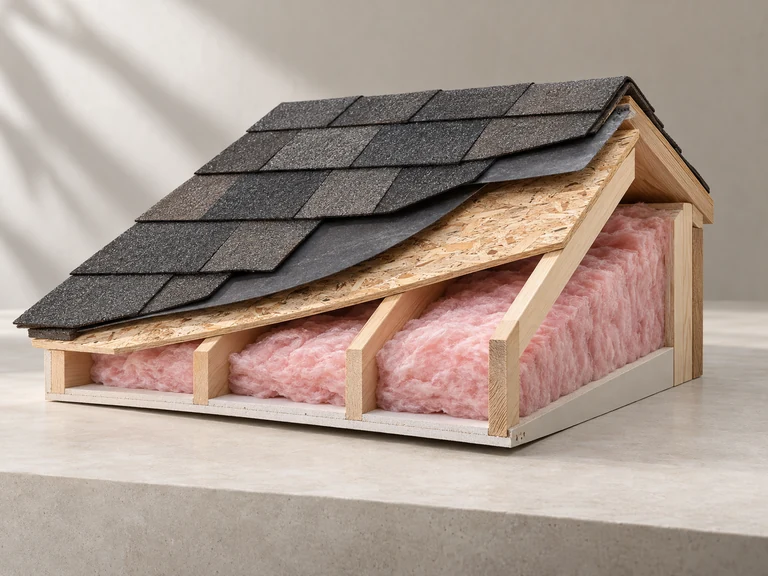
A framed floor, separated into the layers you are actually buying. Open the numbered plates.
- 01
Kraft facing
The tan paper skin is a kraft vapor retarder rated at 1.0 perm under ASTM E96. Its flanges can be inset- or face-stapled, but the facing burns — Owens Corning requires it covered, in substantial contact with the finish material, never left exposed. Whether a cavity needs it is a local-code question.
- 02
The blanket
PINK Next Gen Fiberglas is preformed blanket insulation spun from glass — SCS-certified to average 65% recycled content, with a minimum 47% post-consumer. The fibers are inorganic: not a food source for mold, non-corrosive to steel, copper, or aluminum, and shed-resistant with less dust, per Owens Corning.
- 03
Friction fit
No staples hold this batt. It is cut slightly proud of the cavity and installed by friction fit — completely filling the bay with no voids, gaps, or areas of compression. Owens Corning's instructions start each batt at the top plate and work down, splitting the blanket around wiring and cutting around boxes.
- 04
Full loft
Thickness is the mechanism. An R-13 batt measures 3½ inches — the depth of a 2x4 cavity — and its rating holds only at full loft. Owens Corning specifies product thickness matching framing depth; the U.S. Department of Energy notes compressed insulation will not give its full rated R-value.
- 05
The color
The pink is branding, not chemistry. The color PINK has been a registered Owens Corning trademark since May 12, 1987 — by the company's account, the first color trademark granted in the United States — and every current data sheet still carries the registration line.
Stylized CGI rendering — an illustration of assembly layering, not an Owens Corning drawing.
The businesses, explained
Insulation. Roofing. Doors.
Owens Corning runs three businesses today; Super Arbor stocks the first two deep. The cards explain all three.
R-11–R-49
Insulation
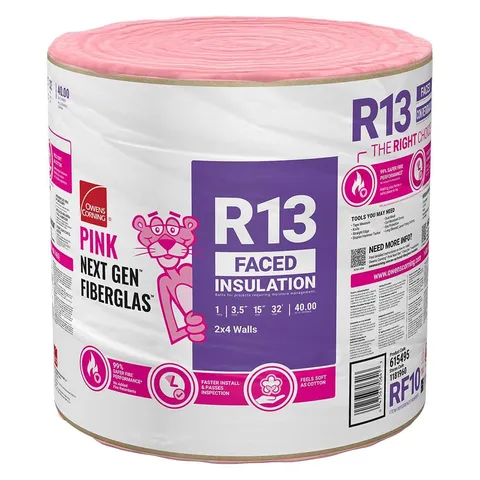
The founding business. PINK Next Gen Fiberglas batts and rolls run from R-11 to R-49 in thicknesses of 3½ to 14 inches — unfaced, kraft-faced, or foil-faced — with widths cut for wood or metal framing. GREENGUARD Certified and validated formaldehyde-free; unfaced batts are classified non-combustible per ASTM E136.
FitsWalls, attics, floors, basements — thermal and acoustic cavities.
Class A
Roofing
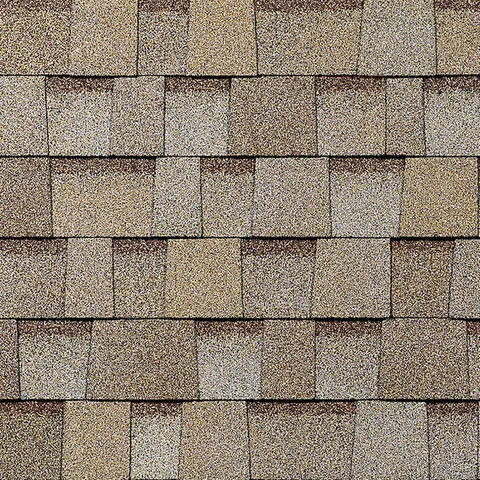
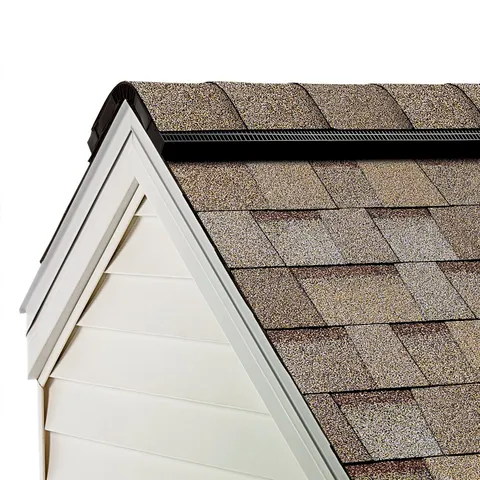
Laminated asphalt shingles on the glass-fiber mat Owens Corning adopted in 1977, led by the Duration series with patented SureNail Technology — a woven reinforcing fabric across the nail zone. TruDefinition Duration lists UL 790 Class A fire resistance, ASTM D7158 Class H wind classification, and a 130-mph wind resistance limited warranty.
FitsSteep-slope residential roofs, starter course through hip and ridge.
2024
Doors
The newest segment. Owens Corning completed its roughly $3.9 billion acquisition of Masonite — a global provider of interior and exterior doors and door systems — on May 15, 2024. The deal extended the company from roof and wall cavities to the opening itself, and Doors now reports as its third segment.
FitsInterior and exterior door systems.
Compression costs R-value. The U.S. Department of Energy's insulation fact sheet is blunt: insulation which is compressed will not give you its full rated R-value. Owens Corning's own instructions call for batts fully in the cavity but not compressed below labeled thickness — never force a thicker batt into a thinner space.
Read the label
Reading a PINK batt label
One specimen string, three fields — the whole physics of a batt is printed on the bag. Read it the way the desk does.
R-13
Thermal resistance
R-value measures resistance to heat flow, tested to ASTM C518 — the higher the number, the greater the insulating power. R-13 is the rating Owens Corning produces at 3½ inches for wood framing; the line runs R-11 to R-49. The rating is a property of the batt at its stated loft, not of fiberglass generally.
3½ × 15 × 93
Cut to the cavity
Geometry does the fitting. The 3½-inch thickness matches a 2x4 stud bay — Owens Corning specifies product thickness equal to framing depth. The 15-inch width is a wood-frame dimension (metal-frame batts run 16 and 24 inches); it friction-fits between studs with no staples required. 93 inches is one of two standard precut wall lengths for wood framing, alongside 105.
KRAFT-FACED
The vapor retarder
Kraft facing is a paper membrane rated 1.0 perm under ASTM E96 — ASTM C665 Type II, Class C. Whether a cavity needs a vapor retarder, and on which side it faces, is a local-code question; Owens Corning directs installers to the applicable building code. The facing burns and must never be left exposed.
Unfaced PINK Next Gen batts are the same blanket without the membrane — ASTM C665 Type I, classified non-combustible per ASTM E136.
The desk's read
How the desk checks a PINK order
The order logic nobody writes down — voiced as our desk's read, not the brand's claim.
Pick by the cavity, not the shelf
The desk's read: measure the framing first. A 2x4 wall takes 3½-inch product (R-13 or R-15); a 2x6 wall takes 5½-inch (R-20, R-21, R-23); attic and floor depths go deeper still. Wood framing takes 15- and 23-inch widths, metal framing takes 16 and 24. Then let local code and the official climate-zone tables set the target R.
The money math is per square foot
The desk's read: batt prices only compare after you divide by coverage. Packages of the same R-value carry different batt counts, widths, and lengths, so compute cost per square foot at your target R before buying — and price the attic job first, where there is usually room to add depth without opening a single wall.
The classic mistake is cramming
The desk's read: a compressed batt is a downgraded batt. Split the blanket around wiring, cut around electrical boxes and tuck the cut-out behind them, and never fold a batt to fit — a fold creates a void across the cavity. Keep 3 inches of clearance off recessed fixtures unless they are IC-rated. Snug, not stuffed.
First buy: seal, then batt, then face
The desk's read: air-seal before you insulate — Owens Corning's own sequence starts at sheathing gaps, penetrations, and the band joist before a single batt goes in. Then choose the facing: kraft-faced where an open cavity calls for a vapor retarder, unfaced for layering or pure sound work. On facing direction, ask local code, not the aisle.
Measured the walls but not sure what fits? Put it on a list and let a specialist run the math. Paste the list, however you have it
The working collection
The roof bench
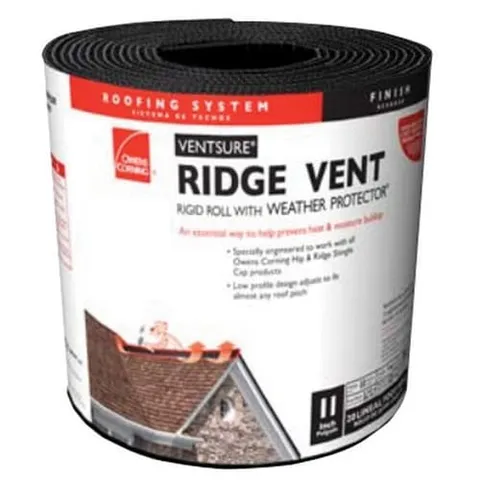
The Duration architecture and the layers under it
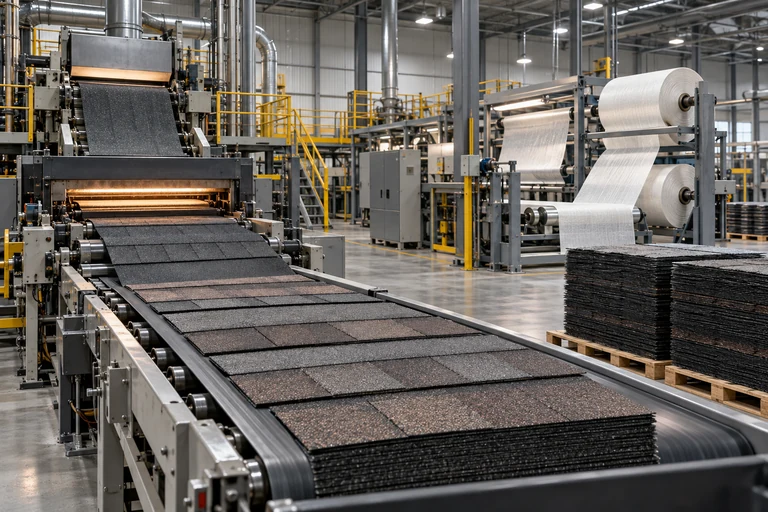
Illustrative production study, not a photograph of the maker's own facility.
Asked at the desk
Questions, answered plainly
Why is Owens Corning insulation pink?
Pink is the brand, not the material. Owens Corning registered the color PINK as a U.S. trademark on May 12, 1987 — the first color trademark granted, by the company's account — and has licensed MGM's Pink Panther as its insulation mascot since August 15, 1980. Its data sheets still carry the line: the color PINK is a registered trademark of Owens Corning.
What does the R-value on a PINK batt mean?
R-value is resistance to heat flow — the higher the number, the greater the insulating power. Owens Corning rates PINK Next Gen Fiberglas from R-11 to R-49, tested to ASTM C518, at thicknesses from 3½ to 14 inches. The rating applies at full labeled thickness; the U.S. Department of Energy notes that compressed insulation will not deliver its full rated R-value.
Should I buy faced or unfaced insulation?
Kraft-faced batts add a 1.0-perm vapor retarder with stapling flanges; unfaced batts are plain blanket, classified non-combustible per ASTM E136. Owens Corning refers the need for and placement of a vapor retarder to local building code. One hard rule either way: kraft facing burns and can never be left exposed — it must sit in contact with the finish material.
Is PINK Next Gen Fiberglas insulation formaldehyde-free?
Per Owens Corning's data sheet, PINK Next Gen Fiberglas is GREENGUARD Certified for low chemical emissions and GREENGUARD-validated to be formaldehyde-free. It is also SCS-certified to contain an average of 65% recycled glass — minimum 47% post-consumer — and its inorganic fibers are not a food source for mold.
What is SureNail Technology on Duration shingles?
SureNail is Owens Corning's patented woven reinforcing fabric strip across the shingle's nailing zone (U.S. Patent 7,836,654) and, per Owens Corning, is available only on its Duration series. The fabric overlays the bond between shingle layers — what the company calls Triple Layer Protection — and anchors the line's 130-mph wind resistance limited warranty.
How many bundles of Owens Corning Duration shingles make a square?
Three. Owens Corning's TruDefinition Duration specifications list 3 bundles per square, 64 shingles per square, and 98.4 square feet of coverage — nominal shingle size 13¼ by 39⅜ inches with a 5⅝-inch exposure. Order by squares of measured roof area, then add allowance for hips, valleys, waste, and starter courses per your estimate.
The hall closes. The envelope holds.
The Owens Corning lines above are live catalog — priced in the open, the same number for everyone. Roofing and insulation are coverage buys: send the list — however you have it — and a human specialist prices every line and checks the math.
Sources: Owens Corning newsroom and investor releases (75th anniversary history, 1938; Pink Panther 40 years, 1980/1987; Masonite completion, 2024; Praana agreement, 2025, and completed sale, 2026; FY2025 results, 2026) · Owens Corning product literature (PINK Next Gen Fiberglas product data sheet Pub. 10024567, submittal sheet Pub. 10024913, installation guide Pub. 10024604; TruDefinition Duration brochure Pub. 10013978) · U.S. Department of Energy Insulation Fact Sheet (DOE/CE-0180) · Fortune company profile. Era and anatomy imagery: styled visualizations, not archival photographs or Owens Corning drawings.
The color PINK is a registered trademark of Owens Corning. PINK Next Gen™, Fiberglas™, TruDefinition®, Duration®, SureNail®, and 1-800-GET-PINK® are trademarks of Owens Corning. THE PINK PANTHER™ & © Metro-Goldwyn-Mayer Studios Inc. Super Arbor is an independent retailer; brand marks remain the property of their respective owners.