
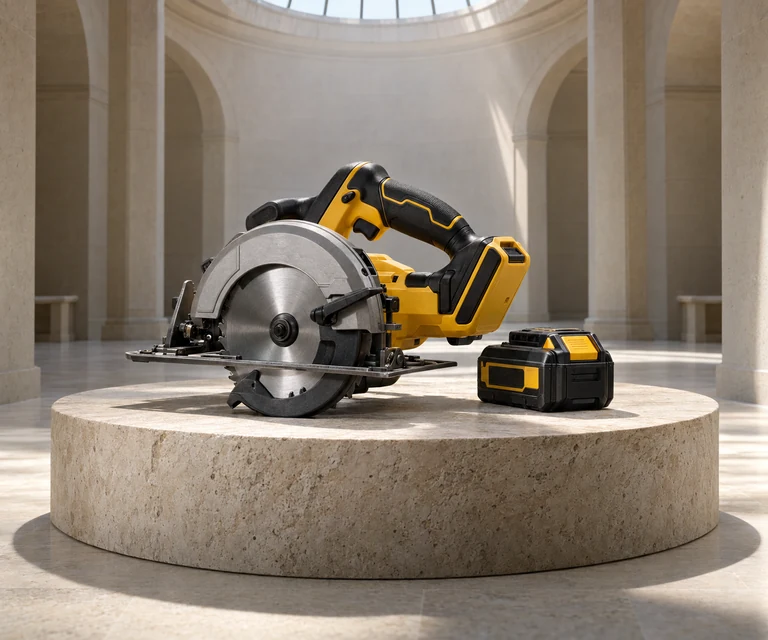
Brand hall
DEWALT
From the Wonder-Worker of 1924 to the battery that changes voltage with the tool — a century of machinery built for the trades.
DEWALT · Towson, MD · est. Leola, PA, 1924Black & Decker company since 1960 · Stanley Black & Decker brand since 2010
This hall reads DEWALT the way a museum reads a maker: by the record. The register begins December 29, 1924, when DEWALT Products Co. was founded in Leola, Pennsylvania, to manufacture Raymond E. DeWalt's radial arm saw, the Wonder-Worker. It runs through the 1992 professional relaunch, the 2011 arrival of 20V MAX, and 2016's FLEXVOLT battery, which changes voltage with the tool. The exhibits decode the model numbers, open the tools to their mechanisms, and map the three battery platforms — so what you carry out is chosen, not guessed.
Wing I
The record
The register, in eight exhibits.
Exhibit 01 — 1924
The Wonder-Worker
DEWALT Products Co. is founded December 29, 1924, in Leola, Pennsylvania, to manufacture Raymond E. DeWalt's adjustable radial arm saw — the machine he called the Wonder-Worker, developed from patent filings begun in 1921. The blade travels along an overhead arm while the stock stays put; tradespeople supplied testimonials within two years.
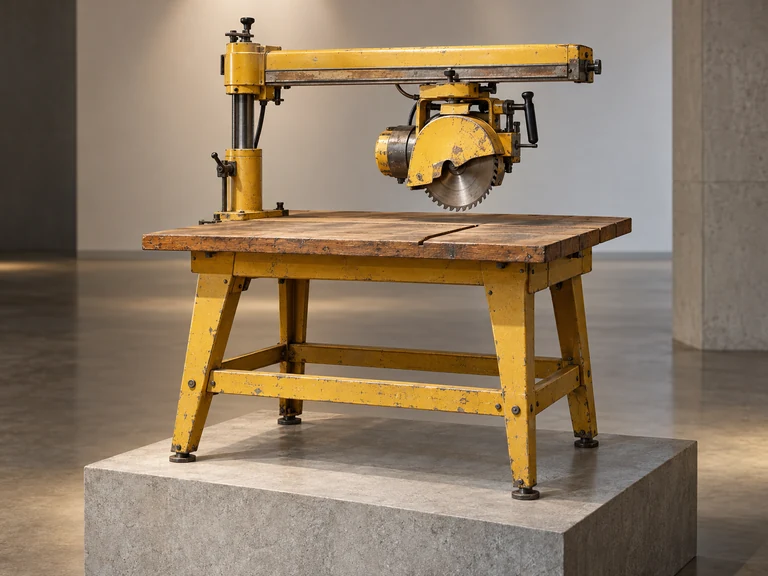
Exhibit 02 — 1941
Defense orders
DEWALT's corporate timeline marks 1941 as the start of rapid expansion to meet wartime government defense orders. In 1942 and 1945 entries, the same timeline records founder Raymond DeWalt teaching the trades — first at the National Youth Administration's shops in York, PA, then among the first instructors in a high-school vocational program — the education thread this hall borrows.
Exhibit 03 — 1960
Into Black & Decker
Black & Decker acquires DEWALT in 1960, an entry the brand's own timeline records plainly. The Pennsylvania radial-arm-saw maker joins the Towson, Maryland power-tool company, and the DEWALT name continues on woodworking machinery.
Exhibit 04 — 1992
The professional relaunch
Black & Decker relaunches DEWALT as its professional power-tool brand, moving its high-end portable electric tools under the yellow-and-black mark. The Baltimore Sun reported the bet as it was made: a name tradespeople still recognized, applied to a full professional line.
Exhibit 05 — 2011
20V MAX arrives
DEWALT announces the 20V MAX lithium-ion cordless system in June 2011 — drills, impact drivers, saws, and a rotary hammer on one slide-pack battery interface, in stores that September. The asterisk is official: maximum initial battery voltage, measured without a workload, is 20; nominal is 18.
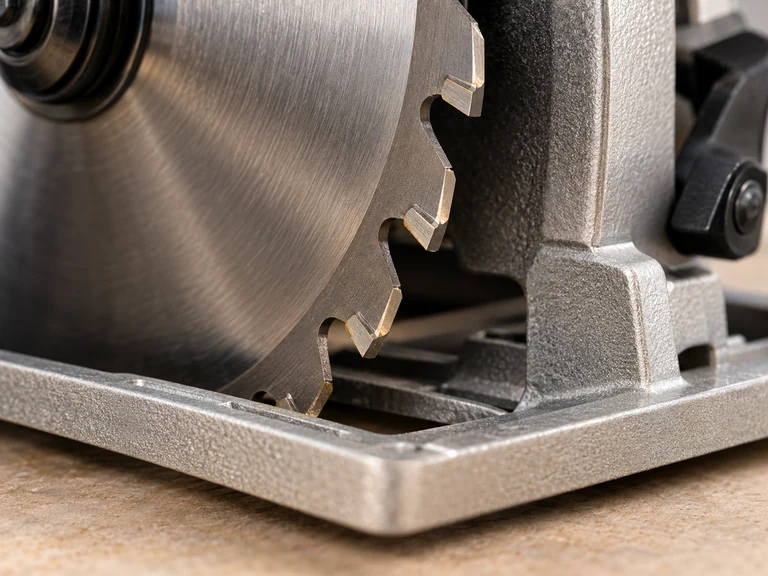
Exhibit 06 — 2016
FLEXVOLT changes voltage
DEWALT introduces FLEXVOLT, describing it as the world's first battery that automatically changes voltage when you change tools: 20V MAX in parallel, 60V MAX in series, 120V MAX from two packs together. Every FLEXVOLT battery also powers the existing 20V MAX tools.
Exhibit 07 — 2021
POWERSTACK pouch cells
DEWALT launches POWERSTACK, a 20V MAX compact battery built from stacked pouch cells rather than cylindrical ones. Per DEWALT's release, it is the first major power tool brand to use pouch cells designed for the construction industry, claiming 50% more power in a 25% more compact pack than its comparison battery.
Exhibit 08 — 2024
POWERSHIFT, one century in
One hundred years after Leola, the brand's official timeline adds POWERSHIFT, a cordless equipment system aimed at the concrete jobsite. The register that opened with a single saw now spans three battery platforms, equipment, and tools under Stanley Black & Decker.
Interactive exhibit
One drill, opened
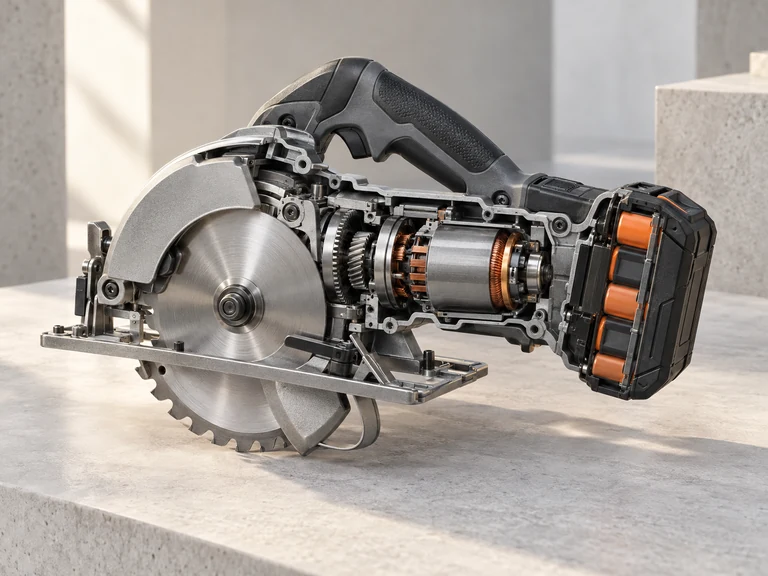
A hammer drill, exploded into the parts the model number describes. Open the numbered plates.
- 01
Brushless motor
There are no carbon brushes in a DCD999-class drill. An electronic controller commutates the motor, switching current through stator coils around a permanent-magnet rotor, so no contact rubs and wears. Less friction means less heat and less of the pack's charge spent inside the housing — the argument behind the brushless motors across DEWALT's XR tools.
- 02
Hammer and anvil
An impact driver's torque arrives as blows. Behind the collet, a spring-loaded hammer rides cams against an anvil that carries the bit; when the fastener resists, the hammer slips, winds up, and strikes — thousands of rotational impacts per minute. The blows land at the anvil rather than the operator's wrist, which is how a compact tool seats long fasteners.
- 03
Ratcheting metal chuck
The DCD999's chuck is specified like an exhibit label: 1/2-inch, metal-bodied, nitro-carburized, ratcheting, with carbide inserts at the jaw faces. Ratcheting means the collar indexes and holds its final tightening to resist hammer-mode vibration backing it off; the hardened surfaces and carbide pads are there to keep their grip on smooth-shank bits under load.
- 04
The battery interface
The rails under the handle are the whole platform argument. Every 20V MAX pack — compact, XR, POWERSTACK pouch-cell, or a FLEXVOLT running in parallel — slides onto the same interface. The pack, not the tool, carries the cells and their electronics, which is how a 2011-era tool can run a battery technology introduced a decade later.
- 05
Three-mode worklight
The LED under the chuck carries its own specification. The DCD999 mounts a three-mode light whose spotlight setting runs a 20-minute shutoff timer, and DEWALT's factory copy rates it up to 20 times brighter than the prior-generation DCD985. The third mode exists for attics, crawlspaces, and panel boxes — places where the drill is the only light on site.
Stylized CGI rendering — an illustration of a cordless drill's parts, not a DEWALT drawing.
The platforms, explained
12V. 20V. FLEXVOLT.
Three platforms under one banner — and one battery that crosses down, never up.
12V MAX
12V MAX — XTREME Subcompact
The small-frame platform. DEWALT rebuilt it around the brushless XTREME Subcompact Series announced in June 2019 — drill/driver, impact driver, screwdriver, 3/8-inch impact wrench, hammer drill — sized for one-handed work overhead, inside cabinets, and in panels. 12V MAX batteries fit 12V MAX tools only; the platform trades interchange for subcompact size and weight.
FitsService calls, trim, panel work
20V MAX
20V MAX — the default platform
The center of the catalog since June 2011, when DEWALT announced the line with drills, impact drivers, saws, and a rotary hammer. One slide-pack interface takes every 20V MAX battery — compact through XR, POWERSTACK pouch cells, and FLEXVOLT packs running in parallel. The asterisk is official: 20 volts is maximum initial voltage, measured without a workload; nominal is 18.
FitsFirst kit and everyday jobsite work
60V MAX
FLEXVOLT — the crossover battery
Launched 2016 as, per DEWALT, the world's first battery that automatically changes voltage when you change tools. Cell groups reconfigure: parallel for 20V MAX tools, series for 60V MAX saws and demolition tools; 120V MAX machines draw two packs at once. Compatibility runs downhill only — every FLEXVOLT battery powers 20V MAX tools, but no 20V MAX battery powers a FLEXVOLT tool.
FitsHigh-draw saws and a shared fleet
Compatibility runs one way. A FLEXVOLT battery steps down to power any 20V MAX tool, but 20V MAX batteries — POWERSTACK included — do not power 60V MAX or 120V MAX FLEXVOLT tools: the packs are keyed not to fit, and the voltage is not there. Read the tool's voltage line before checkout.
Read the number
How to read a DEWALT model number
Specimen: DCD999B, the 20V MAX hammer drill in this hall. The catalog is a cipher; this is the key.
DC
Cordless system prefix
DEWALT's cordless catalog opens with DC; the older DW numbers largely mark corded and legacy tools. The prefix declares the platform before you read another character — a DCD drill and a DCS saw marked 20V MAX, whatever their year, answer to the same packs. Independent catalog guides document the convention consistently across the line.
D999
Category letter + series digits
The third letter is the tool's family: D for drills, F for fastening tools such as impact drivers and wrenches, S for saws, G for grinders, H for rotary hammers, B for batteries and chargers. The digits after it name the specific model — and, per ToolGuyd's guide, they jump around; a higher number is not reliably a newer tool.
B
Package code
B means bare tool: no battery, no charger — DCD999B is the tool sold alone. Kit codes replace the B with a battery letter and a count: DCD800P1 is one 5.0Ah pack, DCF787D1 is one 2.0Ah pack. The letter is the pack size; the digit is how many come in the box.
Voltage carries DEWALT's own footnote: 20V MAX is maximum initial battery voltage, measured without a workload — nominal voltage is 18. The same convention scales to 54 and 108 volts nominal on 60V MAX and 120V MAX FLEXVOLT.
The desk's read
How the desk checks a DEWALT order
The order logic nobody writes down — voiced as our desk's read, not the brand's claim.
Choose the line by the day's work
The desk's read: 12V MAX when the tool rides in a pouch all day — service calls, trim, panels. 20V MAX as the default, because that is where the catalog concentrates. FLEXVOLT where a cord used to be: big saws, demolition, anything that stalls a compact pack. Buy the platform first and the tool second — the batteries, not the tools, are the commitment.
The money math is in the batteries
The desk's read: pay for batteries and a charger once, then stop paying for them. One kitted purchase — a P1 or D1 box — seeds the platform; after that, B-suffix bare tools are the cheaper line on every order. Two packs cover most one-trade days: one on the tool, one on the charger. Count packs before you count tools.
The mistake the amber strip exists for
The desk's read: the classic return is a 60V MAX saw bought against a drawer of 20V MAX packs. They will not mate, by design. Read the tool's voltage line, not the brand color: 20V MAX tools accept every 20V MAX-family pack, FLEXVOLT included, while 60V and 120V MAX tools accept FLEXVOLT only — and 12V MAX packs stay on 12V MAX tools. When in doubt, the FLEXVOLT pack is the one that goes both ways.
The first-buy logic
The desk's read: start with one 20V MAX drill-and-impact kit — the two heads that earn daily — and let its charger and packs anchor everything after. From then on, buy B-suffix bare tools onto the same rails. Add the first FLEXVOLT battery the day the first big saw arrives, not before; it will still serve every 20V MAX tool already on the shelf.
Building the first kit? Put the list together and let a specialist check the platform math. Paste the list, however you have it
The working collection
The 20V MAX bench
The daily four
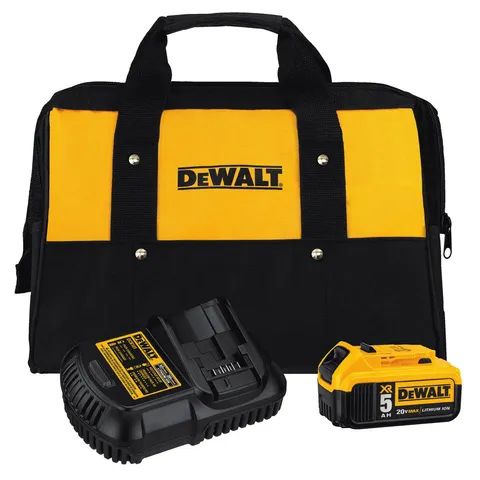
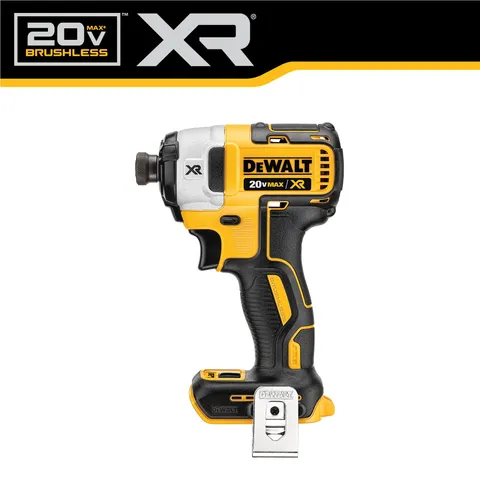
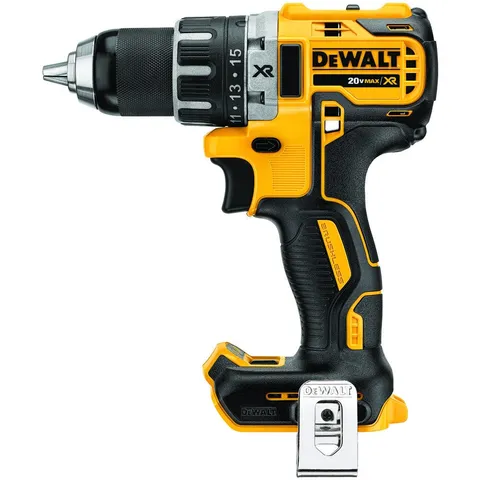
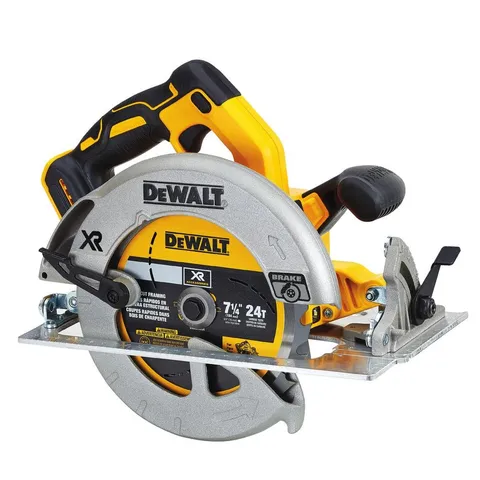
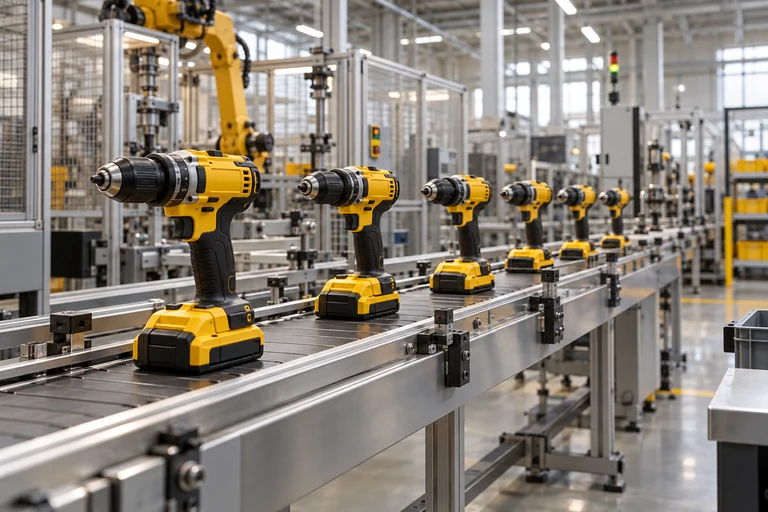
Illustrative production study, not a photograph of the maker's own facility.
Asked at the desk
Questions, answered plainly
Do DEWALT FLEXVOLT batteries work on 20V MAX tools?
Yes. DEWALT states FLEXVOLT batteries are compatible with DEWALT 20V MAX power tools; the pack's cell groups run in parallel to deliver 20V MAX output with extended capacity. The reverse is not true — 20V MAX batteries do not power 60V MAX or 120V MAX FLEXVOLT tools.
What does 20V MAX actually mean?
It is DEWALT's labeled maximum. Per the brand's own footnote, maximum initial battery voltage, measured without a workload, is 20 volts; nominal voltage is 18. The same convention scales across the catalog — 60V MAX is 54 volts nominal, and 120V MAX, drawn from two FLEXVOLT packs, is 108.
What does the B at the end of a DEWALT model number mean?
B marks a bare tool — no battery or charger in the box. DCD999B, for example, is the 20V MAX hammer drill sold as the tool alone. Kit numbers swap the B for a battery letter and count: DCD800P1 includes one 5.0Ah battery, DCF787D1 one 2.0Ah battery.
Who owns DEWALT?
DEWALT is a brand of Stanley Black & Decker. Black & Decker acquired the DeWalt company in 1960, relaunched the name across its professional power tools in 1992, and merged with The Stanley Works in March 2010 to form Stanley Black & Decker, DEWALT's parent today.
When was DEWALT founded?
DEWALT Products Co. was founded December 29, 1924, in Leola, Pennsylvania, to manufacture the adjustable radial arm saw invented by Raymond E. DeWalt — the machine he called the Wonder-Worker. The company dates its history from that year; 'GUARANTEED TOUGH since 1924' is the banner on its official site.
What is DEWALT POWERSTACK?
POWERSTACK is DEWALT's line of 20V MAX batteries built from stacked lithium-ion pouch cells instead of cylindrical cells. Announced in October 2021, it made DEWALT — per its own release — the world's first major power tool brand to use pouch cells designed for the construction industry. POWERSTACK packs fit the standard 20V MAX interface.
The hall closes. The century keeps building.
The DEWALT lines above are live catalog — priced in the open, the same number for everyone. A kit is a platform buy: send the list — however you have it — and a human specialist prices every line and checks the platform math.
Citations: DEWALT corporate history and product pages (dewalt.com); DEWALT and Stanley Black & Decker press releases (PR Newswire, Mynewsdesk); SEC filings (sec.gov); reporting by The Baltimore Sun and Engineering News-Record; catalog documentation by ToolGuyd, Pro Tool Reviews, and Tool Box Buzz; retailer listings at The Home Depot. Era and anatomy imagery: styled visualizations, not archival photographs or DEWALT drawings.
DEWALT®, GUARANTEED TOUGH®, FLEXVOLT®, XR®, XTREME™, POWERSTACK™, POWERSHIFT™, and 20V MAX are trademarks of their respective owner. DEWALT's own notice claims, among others: the yellow and black color scheme; the "D"-shaped air intake grill; the array of pyramids on the handgrip; the kit box configuration; and the array of lozenge-shaped humps on the surface of the tool. Super Arbor is an independent retailer; brand marks remain the property of their respective owners.