
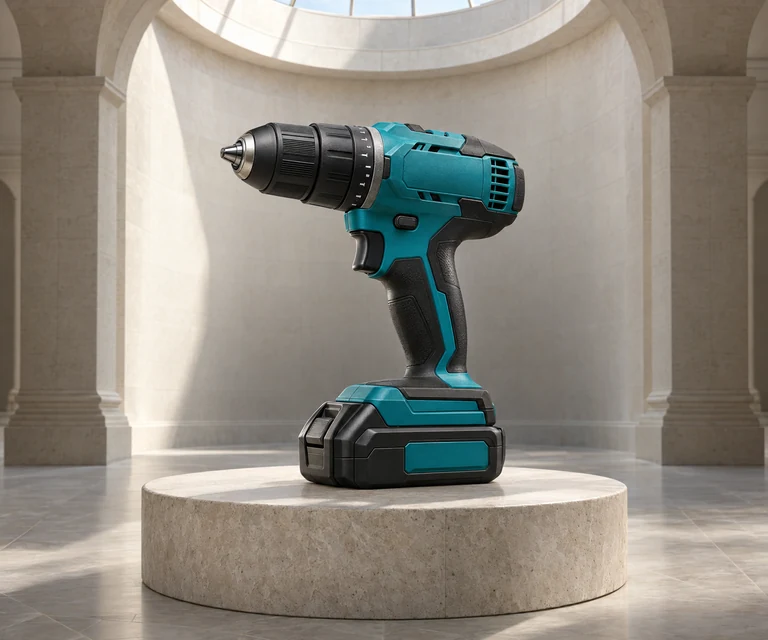
Brand hall
Makita
A century of the jobsite — from a Nagoya motor shop to the cordless platform era.
Makita Corporation · Anjo, Japan · est. Nagoya, 1915TSE 6586 · Ten plants in eight nations
Makita has spent more than a century around electric motors — selling them, repairing them, and, since 1958, building them into portable power tools. This hall is the full record: the history, how the tools are made, how the platform system actually works, and the guidance our desk gives buyers every day.
Wing I
The record
A century, in seven exhibits.
Exhibit 01 — 1915
Founded in Nagoya
In March 1915, Mosaburo Makita founded Makita Electric Works in Nagoya, Japan — a shop selling and repairing lighting equipment, motors, and transformers. It incorporated in 1938.
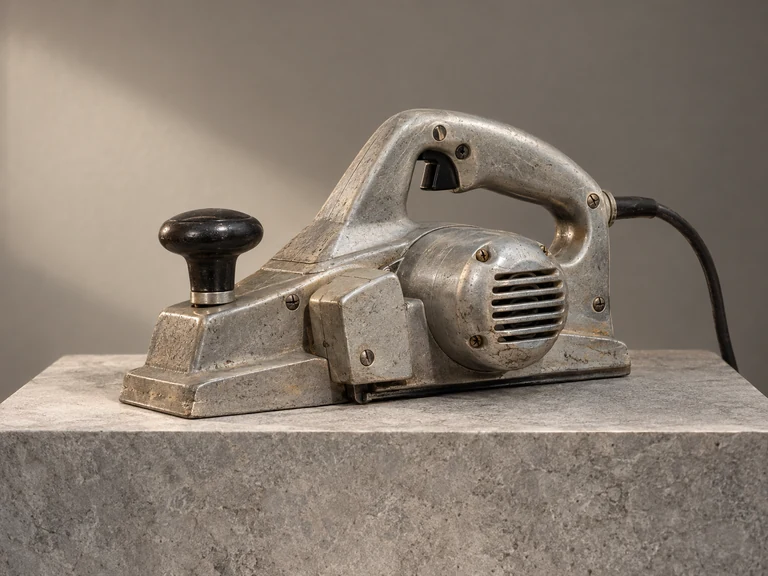
Exhibit 02 — 1958
Japan's first portable electric planer
Makita began marketing the Model 1000 portable electric planer, the first of its kind in Japan. Within two years the company had remade itself as a power-tool maker and shipped its first exports — planers, to Australia.
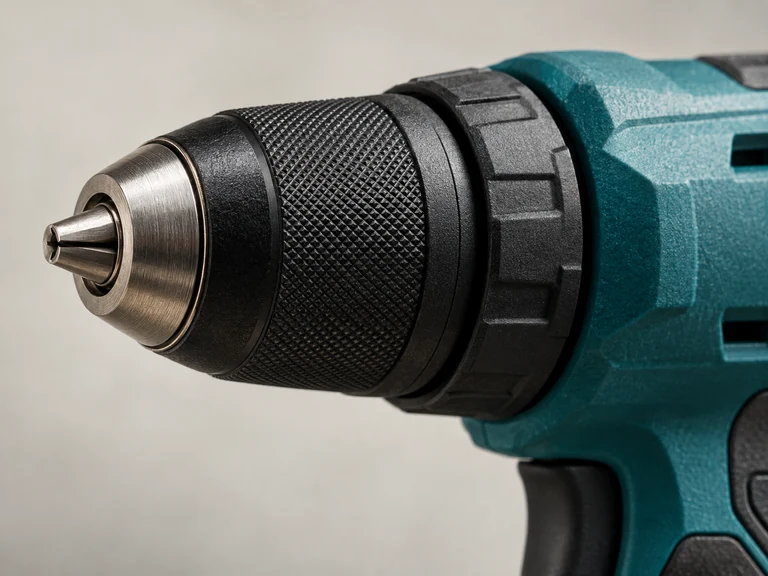
Exhibit 03 — 1969
The battery era begins
The 6500D battery-powered drill arrives — the tool Makita calls its first rechargeable. The company's first nickel-cadmium tool, the 6010D, follows in 1978.
Exhibit 04 — 1970
Makita comes to America
Makita U.S.A. is established in July 1970 — the company's first overseas subsidiary — the same month Makita is designated to the First Section of the Tokyo, Nagoya, and Osaka stock exchanges.
Exhibit 05 — 1985
Made in Buford, Georgia
Makita Corporation of America begins manufacturing power tools in Buford, Georgia — a plant that is still part of Makita's manufacturing network today.
Exhibit 06 — 2005
The lithium-ion era
The TD130D impact driver — Makita's first lithium-ion tool — launches in February 2005. That October, the 18V LXT system reaches the United States; Makita says it was the first to bring 18V lithium-ion to American jobsites.
Exhibit 07 — 2019
XGT: the 40Vmax platform
Makita launches the 40Vmax XGT platform for higher-demand work, engineered to run alongside 18V LXT. XGT reaches the U.S. market in late 2020.
Wing II
Designed for you
How a Makita gets made — from the motor lab to your hands.
Exhibit 08 — Design
It started with the motor
Makita began as a motor company and never stopped being one. Founded in Nagoya in 1915 as Makita Electric Works, it sold and repaired motors, transformers, and lighting equipment for four decades before marketing what Makita records as Japan's first portable electric planer in 1958. The company's own telling is blunt — "It all started with the motor over 100 years ago" — and its brushless motors trace to fastening tools built for defense and aerospace in 2004.
Exhibit 09 — Build
Ten plants, eight nations
Makita U.S.A. describes a global network of ten manufacturing and assembly plants in eight nations — Japan, China, Romania, Thailand, the United Kingdom, Brazil, the United States, and Germany, per the corporate site. The American node is the Buford, Georgia plant of Exhibit 05.
Exhibit 10 — Prove
Evaluated before it ships
Makita describes a quality system that runs from design through mass production, with evaluation for regulatory compliance, functionality, and durability before a product ships, supported by CAE analysis. The discipline is not new — by Makita's own account, its first 7.2V cordless drill reached market in 1978 only after ten years of design and testing to ensure quality.
Exhibit 11 — Yours
The process ends in your hands
The tool that arrives is the last step of a long argument — a motor line refined for over a century, a design evaluated before release, one of ten plants behind it. Open the case of an 18V LXT hammer driver-drill kit; the process ends in your hands.
Interactive exhibit
One tool, opened
A cordless drill driver, separated into what you are actually buying. Open the numbered plates.
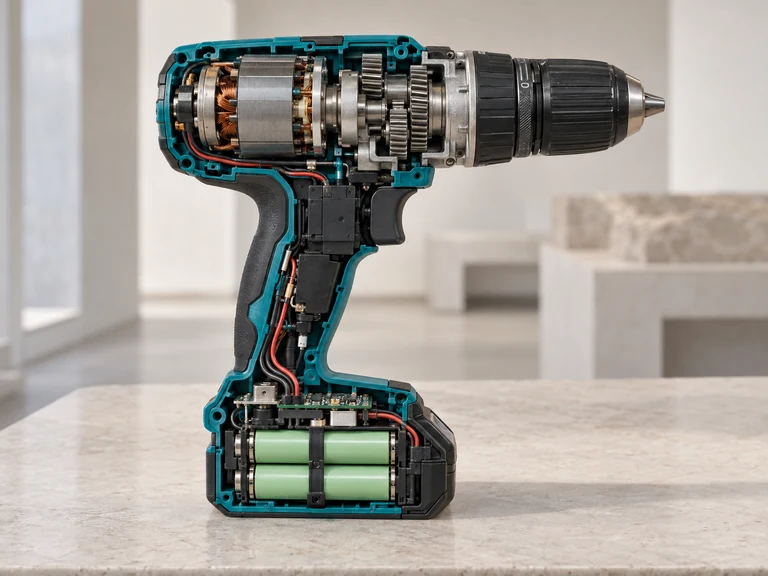
- 01
The chuck
Keyless jaws take round and hex shanks — the last part a century of motor work passes through.
- 02
The gear train
Planetary reduction turns motor speed into usable torque — the ratio between how fast the motor spins and how hard the chuck turns lives here.
- 03
The motor
Brushless means current switches electronically instead of through carbon brushes dragging on a spinning contact. Less friction, less heat — Makita cites up to 50 percent longer run time per charge on its brushless tools.
- 04
The electronics
Star Protection Computer Controls, per Makita, lets tool and battery exchange data in real time — shutting down before overload, over-discharge, or overheating does damage. XPT is Makita's name for the seals that channel dust and water away.
- 05
The battery — the real purchase
The pack is the platform. One 18V LXT battery runs the rest of the line, and the same pack moves from tool to tool.
Stylized CGI rendering — an illustration of cordless-drill architecture, not a Makita engineering drawing.
The system, explained
Three platforms. One rule.
Batteries are the real purchase. They interchange freely within a platform — and never across platforms.
18V
LXT — the main line
LXT is Makita's 18V cordless platform, built on a slide-style lithium-ion battery. Within the platform, packs interchange: current 18V LXT tools share the same batteries, and Makita's 36V-class LXT X2 tools simply run two of them at once.
FitsThe default. Most trades, most jobs — and the deepest tool line.
40V max
XGT — a separate system
XGT is Makita's 40V max platform, built for high-demand work — the applications that would otherwise call for corded, gas, or air power — with 80V max X2 tools running two packs. XGT and LXT batteries are not interchangeable: an LXT pack will not power an XGT tool, nor the reverse. Makita's ADP10 adapter lets an XGT rapid charger charge LXT batteries — charging only.
FitsHigh-demand work that used to mean cords, gas, or air.
12V max
CXT — the compact line
CXT is Makita's 12V max compact platform — 70-plus products on its own smaller slide-style battery. Makita pitches it on ergonomics: compact tools, better balance, precise handling. The lineup leans toward drills, drivers, lights, and measuring tools — the all-day repetitive work where weight and control matter more than maximum torque.
FitsAll-day light work where weight and control lead.
18V LXT and 40V max XGT batteries are not interchangeable — an LXT pack will not power an XGT tool, nor the reverse. Makita's ADP10 adapter covers charging only.
Read the label
How to read a Makita model number
Every Makita SKU tells you three things — the platform, the tool, and what's in the box. Read it right and you never unbox a surprise.
X
The platform
The first letter names the battery platform. X marks 18V LXT tools — XPH03, XDT16, XSH06. G marks 40V max XGT — GPH01, GDT02. Combo kits carry their own prefixes: XT for LXT bundles (XT707PT), GT for XGT.
DT16
The tool
The middle letters are the tool family: DT is an impact driver, PH a hammer driver-drill, SH a circular saw, FD a driver-drill. The digits distinguish models within the family — the letters tell you what the tool is.
T
The box
The trailing letters are what's in the box. Z means bare tool — no battery, no charger. T is a kit with 5.0Ah batteries. M means 4.0Ah, R means 2.0Ah compact. PT marks two 5.0Ah packs and a dual-port rapid charger.
The tool-only trap: order a Z model expecting batteries and you unbox a tool that cannot run — one letter is the difference between a working drill and a second order. (12V max CXT models drop the platform letter; the tool code leads, as in FD09R1.)
The desk's read
What the counter would tell you
The buying logic nobody writes down — voiced as our desk's read, not the brand's claim.
Pick the platform first
Pick the platform first, the tool second — batteries and chargers are the real purchase, and tools just attach to them. Standardize on one system, buy bare tools into it, and your packs rotate instead of multiplying. Split platforms only when the work demands it, and remember the packs don't cross over between LXT and XGT.
Kit math
Batteries and chargers are the real cost of entering a cordless platform, and kits amortize them. Start with a kit — the batteries it includes will power every 18V LXT tool you add later. Once the chargers multiply and the batteries outnumber the tools, switch to Z-suffix bare tools and stop paying for power you already own.
A first Makita, two ways
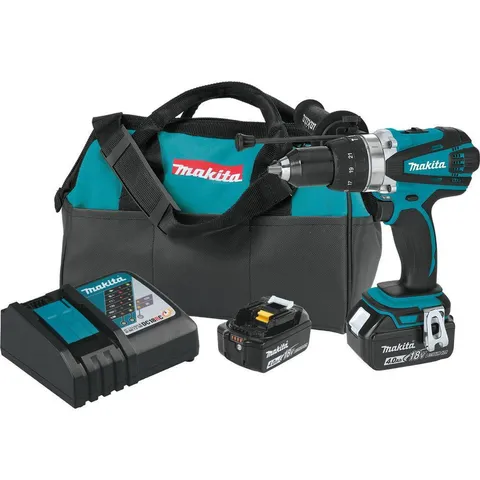
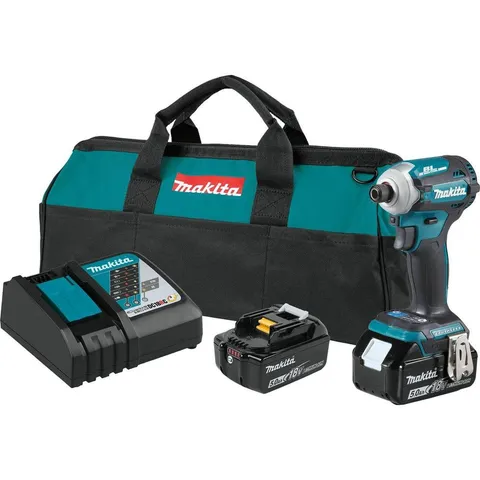
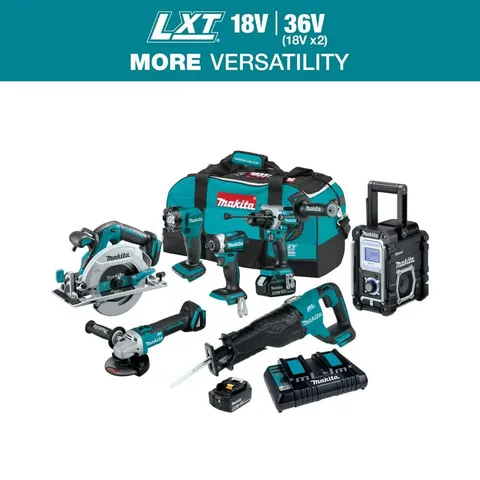
Most home jobs need two tools and rarely more — the 18V LXT Hammer Driver-Drill Kit (XPH03) covers drilling, driving, and the occasional masonry anchor, and the 18V LXT Impact Driver Kit (XDT16T) handles everything with a hex bit. Both arrive with batteries and a charger. A pro crew should skip the à-la-carte phase: the 18V LXT 7-Piece Combo Kit (XT707PT) stands up a whole platform in one box.
Three ways to buy wrong
Platform mixing: batteries only work within their own platform — an 18V LXT pack will not run a 40V max XGT tool — so pick a letter and commit. The tool-only surprise: a Z suffix ships without battery or charger; read the last letter before the price. Ignoring Ah: the 2.0Ah packs in R kits keep tools light, but capacity is runtime, and a long day outworks a small battery.
Not sure which kit fits the job? Put it on a list and let a specialist price it. Paste the list, however you have it
The working collection
Flagships, priced in the open
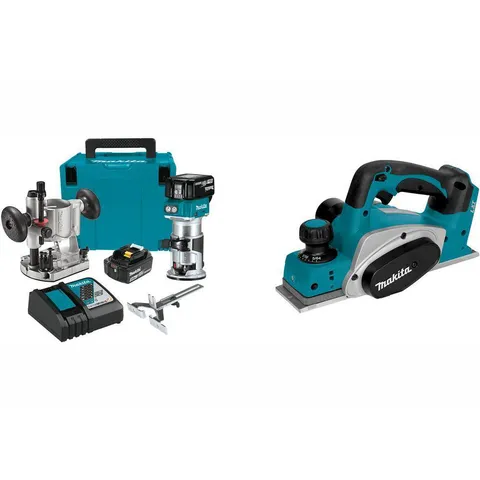
Four working Makita kits from the live catalog — the same number for everyone, no trade license required.
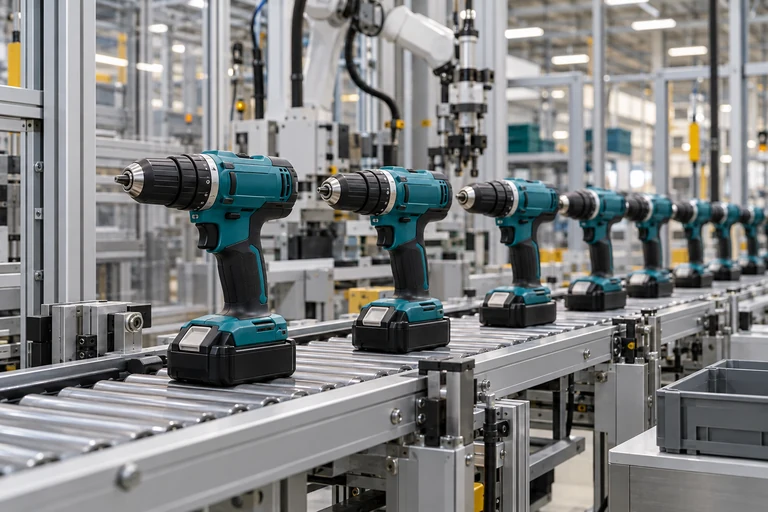
Illustrative production study, not a photograph of the maker's own facility.
Asked at the desk
Questions, answered plainly
Do Makita 18V LXT batteries work in 40V max XGT tools?
No. Makita's 18V LXT and 40V max XGT are separate battery platforms: an LXT battery will not mount in or power an XGT tool, and XGT batteries do not fit LXT tools. The one official crossover is the ADP10 adapter, which lets a 40V max XGT rapid charger charge 18V LXT batteries — a charging accessory only. It does not let LXT batteries run XGT tools.
What does 'Tool Only' or a -Z suffix mean on a Makita listing?
'Tool Only' — usually marked by a Z at the end of the model number, as in XPH03Z — means the box holds the bare tool; battery and charger are sold separately. Makita lists these versions for buyers who already own 18V LXT batteries and chargers and only need the tool. Kit model numbers swap the Z for a different suffix and include batteries and a charger, so check the suffix before comparing prices.
Where are Makita tools made?
Makita is a Japanese toolmaker, founded in 1915 and headquartered in Anjo, Aichi, Japan. Makita describes itself as a global brand sold in over 40 countries, manufacturing at ten plants in eight countries. One of the ten is the manufacturing and assembly plant in Buford, Georgia, operated by Makita Corporation of America. A tool sold in the US may therefore come from Georgia, Japan, or another plant in that network — Makita does not build everything in one country.
What is Makita X2 (36V)?
X2 is Makita's way of reaching 36 volts without leaving the 18V LXT platform: X2 tools carry two battery ports and run on two 18V LXT batteries at once. Both batteries must be installed for the tool to run, and both charge on standard 18V LXT chargers — no new battery platform required.
What does the Ah number on a battery mean in practice?
Amp-hours measure stored energy, not power. Multiply voltage by amp-hours to get watt-hours: an 18V 5.0Ah battery holds 90Wh; a 6.0Ah pack holds 108Wh. In practice, a higher Ah number means longer runtime between charges — Makita rates its 5.0Ah BL1850B at up to 65% more run time per charge than the 3.0Ah BL1830 — not more speed or torque. Those come from the tool's motor. Match capacity to how long you work, not how hard.
What warranty do Makita tools carry in the US?
Makita USA warrants every lithium-ion tool, battery, charger, MAKTRAK modular storage item, and pneumatic nailer against defects in workmanship and materials for three years from the date of original purchase. The ConnectX portable backpack power supply carries a two-year term. Service runs through Makita factory and authorized service centers, which repair or replace defective units at no charge. Coverage excludes normal wear and misuse — including, Makita specifies, running non-genuine 'knock-off' batteries on its tools or chargers.
What should my first Makita purchase be?
The desk's read: start with a kit, not a bare tool — kits include the batteries and charger that tool-only listings leave out. For most first buyers that means an 18V LXT Hammer Driver-Drill Kit (XPH03, stocked above); add the 18V LXT Impact Driver Kit (XDT16T) if you drive fasteners all day. Outfitting a shop from zero, start at the 18V LXT 7-Piece Combo Kit (XT707PT). Every battery you buy runs the rest of Makita's 350-plus product LXT line.
The exhibit ends. The jobsite doesn't.
The tools above are live catalog — priced in the open, the same number for everyone. Buying more than one thing? Send the list — however you have it, and a human specialist prices every line.
Timeline and facts: Makita corporate history (makita.biz/company/about/history), Makita U.S.A. (makitatools.com — LXT, XGT, CXT, warranty, and product pages). Named-technology and scale statements are Makita's own, quoted with attribution. Era and anatomy imagery: styled visualizations, not archival photographs or engineering drawings.
Makita, LXT, AVT, the Makita logo, the Teal color and the Black & White color combination are registered trademarks of Makita. Super Arbor is an independent retailer; brand marks remain the property of their respective owners.